Educational illustration · Read the evidence and limitations below.
Evidence in perspective
The large cardiac-surgery trial’s neutral outcome carries more clinical weight for that indication than mouse endurance experiments. Neither the disease population nor the IV trial product validates exercise enhancement in healthy users.
About this assessment
Existing source snapshot critically reassessed.
Based on the selected source scope described in this profile, often an indexed abstract. Full methods and clinician sign-off remain pending; no systematic-review claim.
The 3,080-participant RED-CABG trial stopped for futility and did not improve its primary composite outcome; mouse exercise results cannot establish benefit for healthy people.
Exact study context; no performance-use extrapolation.
A targeted source review, not a complete clinical monograph. Product stability, long-term safety, interactions and jurisdiction-specific authorization require further verification. Research findings do not validate commercial vials.
How it works
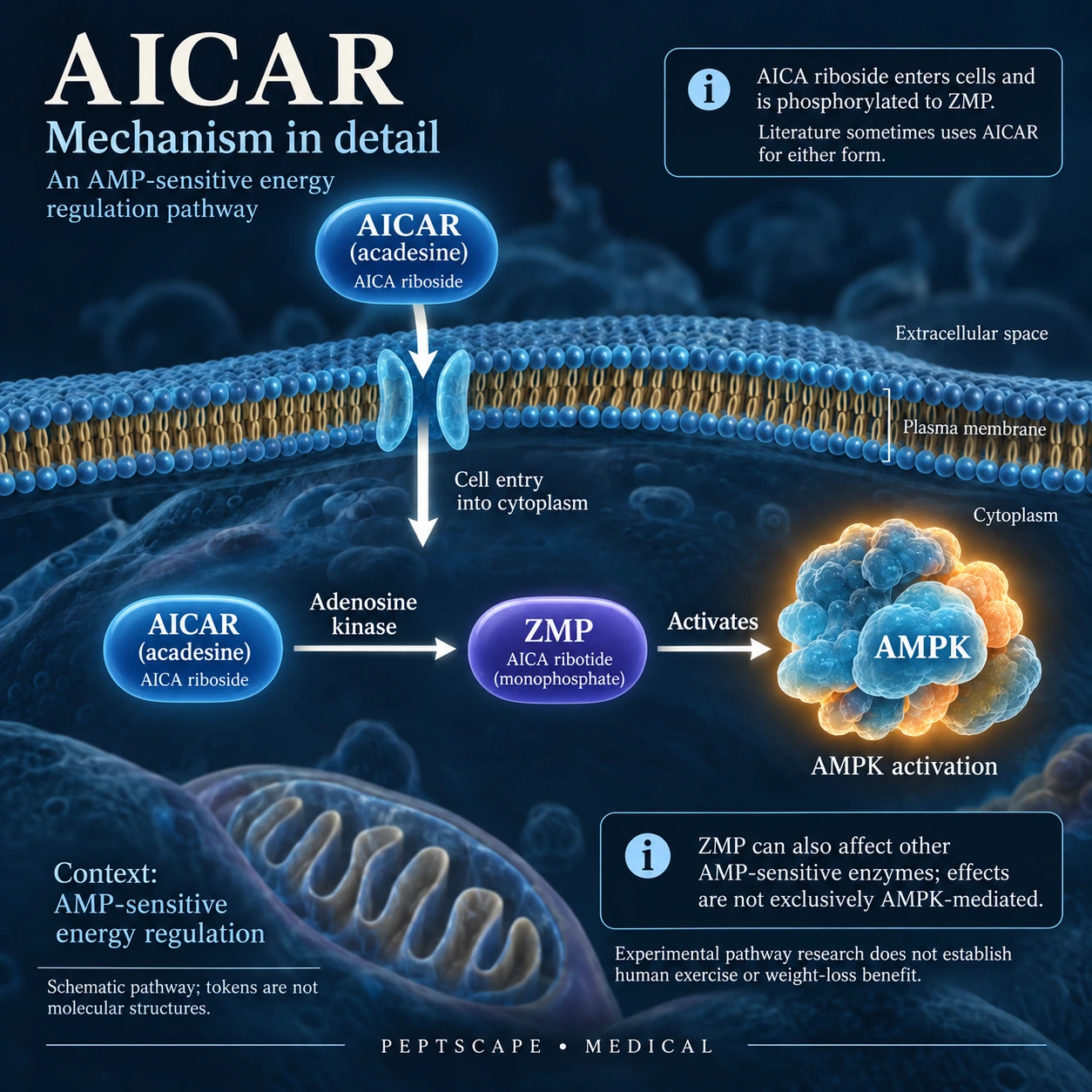
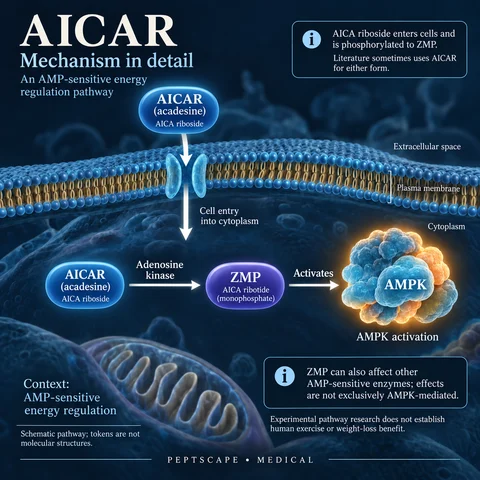
AICA-riboside is used to study cellular energy signalling. Narkar and colleagues investigated AMPK-related metabolic responses and endurance in mice.
AICA-riboside is used to study cellular energy signalling. Narkar and colleagues investigated AMPK-related metabolic responses and endurance in mice.
Exact study context; no performance-use extrapolation.
This catalog identifies human research. A trial can be early, small or negative; its existence does not establish approval or benefit for every proposed use. Check the study population and outcomes.
Transient elevation of uric acid was observed in the high-dose group of the 1995 surgical trial; this does not characterize safety for other uses.
Contraindications
The reviewed evidence does not establish a complete clinical contraindication profile.
Human trials
This catalog identifies human research. A trial can be early, small or negative; its existence does not establish approval or benefit for every proposed use. Check the study population and outcomes.
AICAR in this entry means acadesine, or AICA-riboside: a non-peptide research compound. Mouse exercise experiments and human cardiac-surgery trials answer different questions; neither establishes a personal endurance or longevity regimen.
Exact study context; no performance-use extrapolation.
The 3,080-participant RED-CABG trial stopped for futility and did not improve its primary composite outcome; mouse exercise results cannot establish benefit for healthy people.
Exact study context; no performance-use extrapolation.
Historical CABG research used a continuous IV infusion of 0.05 or 0.1 mg/kg/min for 7 hours, plus acadesine in cardioplegia. These are infusion rates in a surgical trial, not bolus doses or a subcutaneous regimen.
Exact study context; no performance-use extrapolation.