Educational illustration · Read the evidence and limitations below.
What is AICAR?
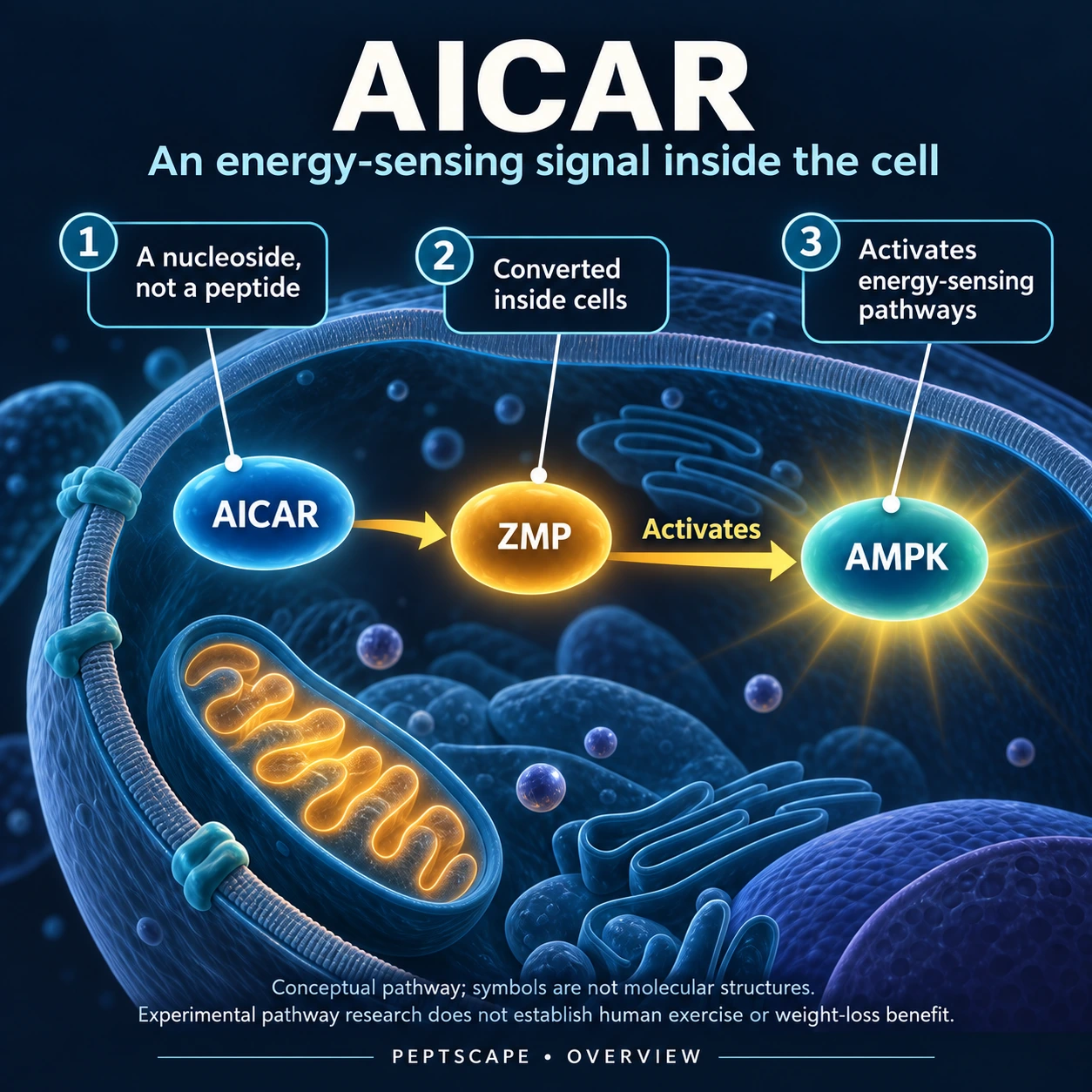
AICAR, also called acadesine or AICA-riboside in this context, is a non-peptide compound used to study cellular energy sensing. It is often associated with the phrase exercise mimetic because of its connection to AMPK, a signal involved in responding to energy demand. That phrase does not mean it reproduces the full benefits of exercise.
The wider picture
Fat metabolism is the way the body stores, releases and uses fat. It is different from appetite: a compound can act on a metabolic pathway without making a person feel less hungry. It is also different from losing water, which can move the scale quickly without removing much stored fat. Understanding the target helps explain why metabolic compounds cannot be compared simply by how many kilograms are lost in the first week.
There are several fat stores in the body. Subcutaneous fat sits beneath the skin; visceral fat surrounds internal organs; liver fat is stored within the liver. They can respond differently during weight change. A smaller abdomen is encouraging information, but it is not an exact measurement of any one compartment. A body-composition claim should say which outcome it actually concerns.
What it is used for
Interest includes glucose handling, endurance biology and responses to reduced oxygen supply. These are separate applications. Exercise also trains the heart, blood vessels, nervous system and movement skills; activating an energy-related pathway cannot be assumed to reproduce those adaptations. AICAR is not a simple alternative for someone unable or unwilling to train.
Understanding the intended benefit
For body composition, separate total weight, waist size and physical function. A smaller waist can be useful, but a tape measure cannot tell precisely how much fat came from around the organs rather than beneath the skin. Strength and everyday activity help reveal whether a weight change is accompanied by loss of useful muscle. Fatigue, persistent weakness and difficulty eating are problems to investigate, not signs that a metabolic intervention is working especially well.
Insulin resistance means that tissues respond less effectively to insulin, so the body may need more insulin to handle the same glucose load. This can coexist with normal glucose results for a time. It is different from simply eating too much sugar on one occasion. A metabolic compound's effect on insulin-related markers and its effect on body weight therefore answer different questions.
How it works
After entering cells, AICAR can be converted into a molecule that resembles part of the cell's low-energy signalling system. This can influence AMPK and other processes. The effects are not limited to a single muscle or a single metabolic switch. It is also different from a mitochondrial uncoupler: sensing energy demand and reducing the efficiency of energy capture are different mechanisms.
The biology in plain language
Cells respond to several overlapping messages about food availability and energy demand. An enzyme is a protein that helps a chemical reaction happen; a receptor receives a signal; a hormone carries a message between tissues. Changing one of these steps can affect more than one organ. This is why a plausible fat-metabolism mechanism is a starting point for understanding a compound, rather than a guarantee of a particular weight-loss result.
Sustainable fat loss also depends on the balance between energy intake and expenditure over time. A pathway affecting fat cells does not make meals, activity or muscle maintenance irrelevant. Protein supports tissue maintenance, and resistance exercise supplies a different signal from a metabolic compound. These are complementary physiological needs, not a claim of a proven supplement-and-peptide synergy.