Identity
Adipotide is an experimental peptidomimetic designed to target blood vessels in white fat. Its animal weight-loss findings do not establish a safe human obesity treatment.
Nonhuman-primate experiment; not a human product specification.
Peptide library
Your guide to this compound.
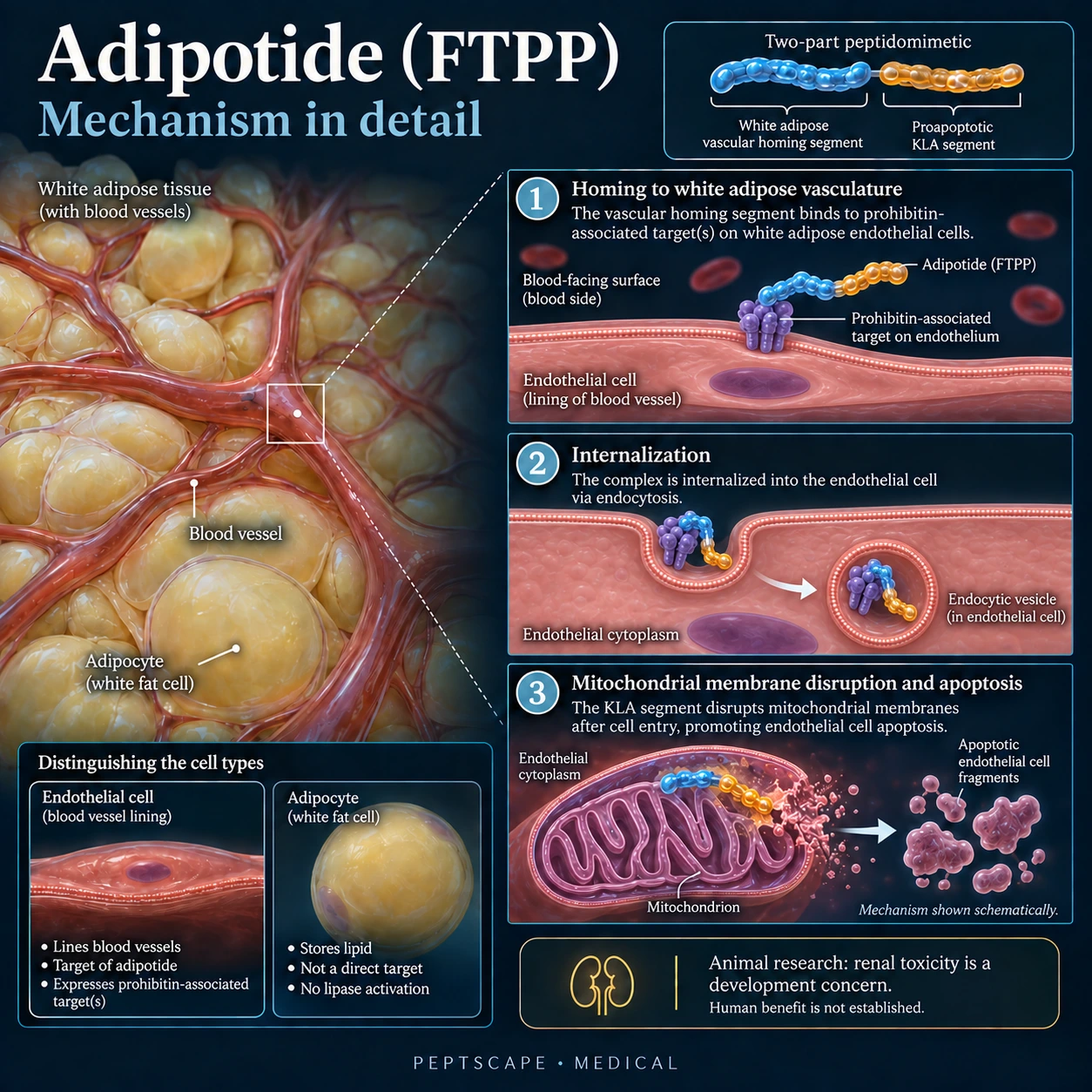
Weight loss in obese monkeys is a translational signal, but the same development work raises renal toxicity concerns. Reversibility in animals does not establish an acceptable human treatment window.
Existing source snapshot critically reassessed.
Based on the selected source scope described in this profile, often an indexed abstract. Full methods and clinician sign-off remain pending; no systematic-review claim.
Editorial assessment · 2026-09-07
Nonhuman primates, including obese rhesus monkeys; not a controlled human obesity trial.
Obese rhesus monkeys lost weight, but kidney tubular injury and altered renal function were observed. Animal reversibility does not establish human safety.
Nonhuman-primate experiment; not a human product specification.
A targeted source review, not a complete clinical monograph. Product stability, long-term safety, interactions and jurisdiction-specific authorization require further verification. Research findings do not validate commercial vials.
The construct combines an adipose-vascular targeting segment with a cell-death-promoting segment. The primate study examined fat loss and metabolic changes.
The construct combines an adipose-vascular targeting segment with a cell-death-promoting segment. The primate study examined fat loss and metabolic changes.
Nonhuman-primate experiment; not a human product specification.
The catalog primarily cites laboratory or animal research. Human benefit, a safe dose and long-term risks cannot be inferred from those findings.
The catalog primarily cites laboratory or animal research. Human benefit, a safe dose and long-term risks cannot be inferred from those findings.
Adipotide is an experimental peptidomimetic designed to target blood vessels in white fat. Its animal weight-loss findings do not establish a safe human obesity treatment.
Nonhuman-primate experiment; not a human product specification.
The construct combines an adipose-vascular targeting segment with a cell-death-promoting segment. The primate study examined fat loss and metabolic changes.
Nonhuman-primate experiment; not a human product specification.
Obese rhesus monkeys lost weight, but kidney tubular injury and altered renal function were observed. Animal reversibility does not establish human safety.
Nonhuman-primate experiment; not a human product specification.
The primate experiment is not a human dosing protocol. No human regimen is supplied.
Nonhuman-primate experiment; not a human product specification.
No validated human elimination half-life was established by the cited primate study.
Nonhuman-primate experiment; not a human product specification.
Barnhart et al. A peptidomimetic targeting white fat causes weight loss and improved insulin resistance in obese monkeys. Sci Transl Med. 2011.
Catalog review date: Sep 6, 2026. This date alone does not establish independent clinical review.