Educational illustration · Read the evidence and limitations below.
Medical · What is SS-31?
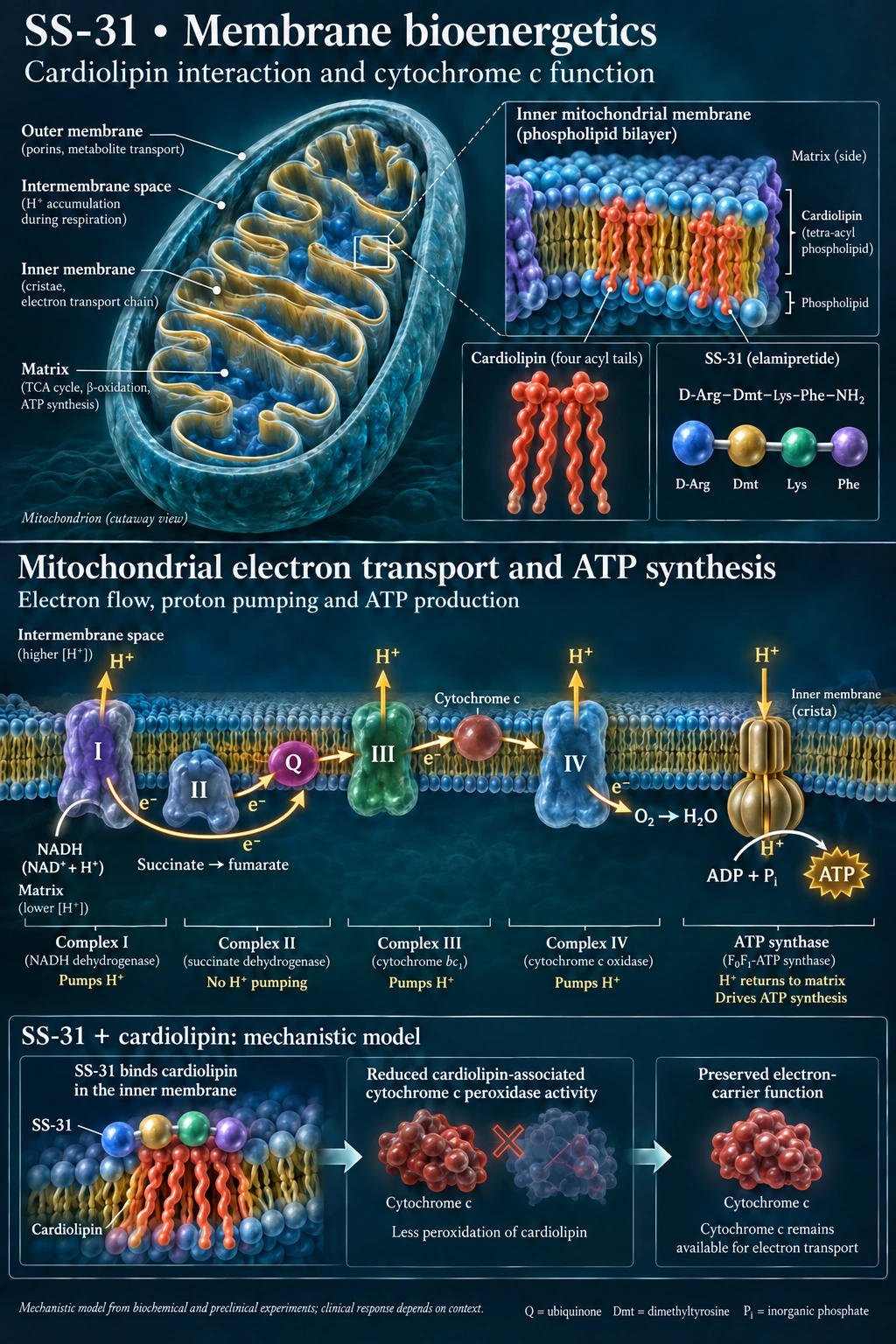
SS-31, also called elamipretide, is a four-amino-acid peptide designed to interact with mitochondria, the structures inside cells that help turn nutrients into usable energy. It is discussed in relation to fatigue, muscle function, ageing and mitochondrial disease.
Its main target is cardiolipin, a fat-like molecule in the inner mitochondrial membrane. That membrane holds much of the machinery used to make ATP, the cell's readily usable energy currency. SS-31 is therefore different from simply supplying more calories or taking a stimulant.
There is now a specific U.S. medicinal use of elamipretide for Barth syndrome. That is an important development, but it does not establish SS-31 as a general anti-ageing treatment or prove that it improves energy in otherwise healthy people. The condition, formulation and measured outcome remain important.
Medical · Benefits and common reasons for interest
Muscle function in mitochondrial disease
Mitochondrial disorders can make ordinary activity exhausting because energy production is impaired. Elamipretide has been tested in these conditions, with results that differ between studies and diagnoses. It should not be presented as a universal treatment for mitochondrial symptoms.
Fatigue and exercise tolerance
People often encounter SS-31 when looking for better stamina. A large phase 3 study in primary mitochondrial myopathy did not show significant benefit on its main walking and fatigue outcomes. Smaller or later subgroup findings should not erase that result.
Healthy ageing
Mitochondrial function changes with age, which provides a reason for research. It does not prove that injections reverse ageing, increase lifespan or replace evaluation of anaemia, sleep problems, heart disease or other causes of fatigue.
Medical · How does it work?
The inner mitochondrial membrane needs a suitable structure for energy-producing proteins to work together. Cardiolipin helps support that structure. SS-31 binds in this environment and is investigated for effects on membrane organisation and mitochondrial function.
This is more specific than describing it as an antioxidant that “cleans all free radicals.” Oxidative stress is one part of a much larger system. A molecular effect may be promising without producing a measurable improvement in walking, strength or daily symptoms.
ATP is not a stimulant. Even if cellular energy handling changes, a person may not feel an immediate burst of energy. Sensation after an injection is not a test of mitochondrial repair or product quality.
Medical · SS-31, MOTS-c and the medicinal formulation
MOTS-c is a different peptide studied in metabolic signalling. NAD precursors are different substances again. These names are often grouped under mitochondrial health, but they do not share one mechanism, dose or demonstrated combination benefit.
Forzinity is a ready-to-use elamipretide formulation with a narrow U.S. indication in Barth syndrome. Its existence provides specific instructions for that medicine. It does not validate a lyophilised SS-31 research vial, and its concentration should not be copied onto another preparation's label.
Medical · Dosing and concentration
The cited Barth syndrome label specifies 40 mg subcutaneously once daily for patients weighing at least 30 kg, with a lower adult dose in severe renal impairment. This is a disease-specific medicinal schedule, not a general wellness dose. The labelled solution is 80 mg/mL, so its 40 mg dose occupies 0.5 mL.
Online SS-31 schedules frequently use different amounts and short courses for fatigue or ageing. Those practices have not been shown equivalent to the medicinal programme. A trial dose is not evidence that the same amount will benefit someone without the studied disease.
A preparation's total milligrams and concentration must be recorded separately. Half a millilitre of a different solution may contain a very different amount. Kidney function is particularly relevant to exposure, so a concentration calculation cannot replace individual review.
Medical · Preparation and reconstitution
The approved elamipretide solution is ready to use; it should not be reconstituted or diluted with bacteriostatic water. It is a defined formulation, not a lyophilised vial.
Lyophilised SS-31 means freeze-dried research material. Preparing it requires documentation of the exact substance, compatible diluent, concentration and storage limit. Bacteriostatic water's preservative does not establish equivalence to the medicinal solution or make contaminated material sterile.
Do not mix SS-31 with MOTS-c or other products in the same syringe. Even when compounds are discussed together, their compatibility has to be established separately. Keep the original container and a clear record of strength, preparation or opening date and discard date.
Medical · Administration
For the cited medicinal formulation, subcutaneous administration uses the abdomen or outer thigh with site rotation. It is not an intravenous wellness injection. A clinician should demonstrate the correct device and measuring technique before home administration.
Use clean hands and a clean work area, inspect the solution as directed and use new sterile equipment. Avoid tender, bruised, red, hardened or scarred skin. Put used sharps directly into a sharps container. An injection near a tired muscle does not target that muscle's mitochondria selectively.
Local reactions can be troublesome. Keep a record of location, size, timing and persistence rather than repeatedly using the least sensitive site. A spreading or severe reaction needs assessment, and uncertain delivery should not prompt an automatic repeat dose.
Medical · Oral versus subcutaneous delivery
Subcutaneous administration bypasses digestive breakdown and is the route used in the medicinal programme. The formulation has measured high systemic bioavailability, but that finding belongs to that preparation and route.
An ordinary oral SS-31 product cannot be assumed to reach the same exposure. A peptide may need a specialised delivery system to survive gut processing and cross the intestinal barrier. A local gut effect is not the established reason for SS-31's mitochondrial-disease use; the intended targets include tissues beyond the digestive tract.
Higher bloodstream exposure alone does not prove better function. The clinical question remains whether the intervention improves a meaningful outcome for the person's condition.
Medical · Half-life
SS-31 exposure falls over hours rather than a full week, and kidney function affects clearance. The cited U.S. label does not provide a single elimination half-life number. The frequently repeated “four hours” should not be treated as a universal value or a reason to redose throughout the day.
Medical · Storage
The cited ready-to-use medicinal vial is refrigerated at 2–8°C before use and must not be frozen. After opening, its instructions permit refrigerated or specified room-temperature storage and require disposal after eight days. This limit belongs to that formulation.
A lyophilised or reconstituted SS-31 preparation needs its own documented stability instructions. Do not borrow the eight-day rule or a general 28-day rule. Record opening and preparation dates, protect the container as directed and avoid direct contact with freezing packs during travel.
Medical · Contraindications and side effects
Serious hypersensitivity is a contraindication for the medicinal formulation. Injection-site reactions are common. A severe or spreading rash, breathing difficulty or facial swelling needs urgent assessment, and a serious allergic reaction should not be tested again with a smaller amount.
Kidney impairment can increase exposure and requires dose review in the medicinal setting. Pregnancy, breastfeeding and uses outside the studied population need individual assessment. The ready-made formulation contains benzyl alcohol and is not for neonates.
Fatigue deserves a diagnosis. SS-31 should not replace assessment for heart disease, anaemia, sleep apnoea or endocrine disorders. New breathlessness, chest pain, fainting or profound weakness should not be interpreted as a normal mitochondrial “adjustment.”
Medical · Nutrition and supplement support
Energy intake and fatigue
Mitochondrial disease nutrition should be planned with the treating team. Some people need advice about meal timing, avoiding prolonged fasting or adapting intake during illness. A healthy person's fatigue does not automatically require the same disease-specific approach.
Protein and activity
Adequate protein and an appropriate activity programme support muscle function. The right exercise intensity depends on health and symptoms; pushing through marked exercise intolerance is not a test of commitment. Keep food intake and functional changes visible in the same record.
CoQ10, riboflavin and other supplements
These may be considered in particular mitochondrial diagnoses, but they are not universal SS-31 companions. Benefits can depend on the disease mechanism. A supplement list from another person's mitochondrial clinic is not a personalised plan.
Creatine, antioxidants and nutrient gaps
Creatine may have separate exercise-related uses, but a proven SS-31 synergy has not been established. Large antioxidant stacks do not automatically improve mitochondrial function. Iron, B12 or vitamin D should address a recognised need; excess iron can be harmful. Review all supplements with the clinician, particularly when kidney disease or complex treatment is present.
Medical · Tracking progress and common questions
Record specific functional goals: walking a familiar route, managing stairs or completing daily tasks. Note fatigue, sleep, illness and activity level. A repeated measure under similar conditions is more useful than a vague feeling of “better mitochondria.”
“Does approval mean it is proven for anti-ageing?” No: the indication is specific. “Is every SS-31 vial the same as the medicine?” No. “Should I feel it immediately?” An immediate sensation does not establish benefit. Persistent or worsening fatigue needs a broader assessment, even if a peptide is being used.
Medical · Medical
U.S. accelerated approval concerns improved muscle strength in Barth syndrome, with confirmatory requirements. The earlier randomised period and the later open-label findings answer different questions. Primary mitochondrial myopathy trial results should be considered separately.