Educational illustration · Read the evidence and limitations below.
What is PL8177?
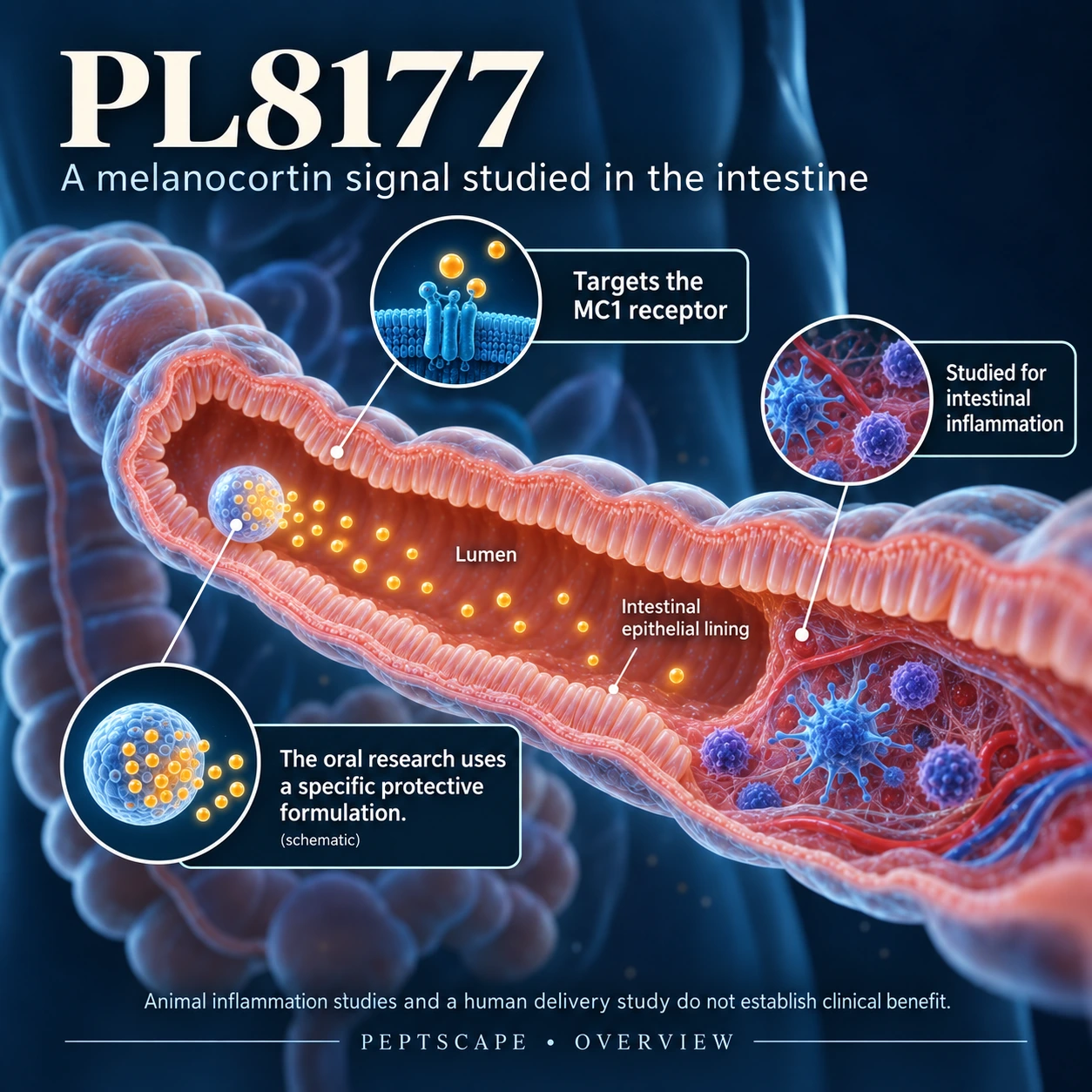
PL8177 is a selective melanocortin-1 receptor agonist developed in part for inflammatory conditions of the gut. Its specialised oral formulation is an important part of that approach. It is not a general tanning peptide despite the melanocortin connection.
The wider picture
The intestine absorbs nutrients and fluid while maintaining a barrier between its contents and the rest of the body. It also has its own nerves, immune cells and hormone signals. A peptide intended to act in the gut may target fluid movement, the lining or a particular inflammatory pathway. These are different purposes, so diarrhoea, constipation and impaired absorption should not be treated as the same problem.
Gut symptoms can arise from movement, secretion, sensitivity, inflammation or structural disease. Constipation can coexist with abdominal pain without proving damage to the lining. Bloating does not itself establish increased intestinal permeability. Matching the target to the actual problem helps explain why two gut-related peptides may have very different uses.
What it is used for
The intended goal is local control of inflammatory signalling in the intestine. This differs from suppressing all immune activity or supplying a systemic tissue-repair signal. A purpose-built oral delivery system cannot be replaced by swallowing an unspecified peptide powder and assuming that it reaches the same location.
Understanding the intended benefit
Local action can explain why an oral peptide is useful even when little reaches the bloodstream. For a gut target, the desired destination may be the intestinal surface itself. This differs from an oral product intended to deliver a peptide throughout the body. Low blood exposure is therefore not automatically a failure, but neither does it prove that any swallowed peptide reaches the correct part of the gut in an active form.
A local intestinal target can be useful precisely because the medicine acts where it is delivered. That is different from treating poor absorption as a universal advantage. The compound must remain active, reach the right region and act at a relevant target. A protective coating or specialised delivery system may be as important as the peptide sequence.
How it works
The melanocortin-1 receptor participates in more than pigmentation. In relevant tissues, activating it can influence inflammatory responses. Formulation determines where the compound is released and whether it remains available at that target. The distinction between local delivery and systemic exposure is therefore central to understanding PL8177.
The biology in plain language
The formulation helps determine where a peptide is released and how long it remains available. Digestion, acidity, food and protective coatings can all matter. An injection bypasses the digestive tract but does not necessarily reproduce the local effect of an oral medicine. For digestive symptoms, stool pattern, pain, fluid intake and weight provide useful context. Blood in the stool, persistent vomiting, severe abdominal pain or signs of dehydration need prompt clinical attention.
Hydration is not only a matter of drinking plain water. Significant fluid loss can also involve salts, and some intestinal disorders alter how well fluids are absorbed. Persistent diarrhoea, dizziness or reduced urination warrants assessment. Food changes, fibre and other medicines can influence symptoms, so they belong in the same record when evaluating bowel function.