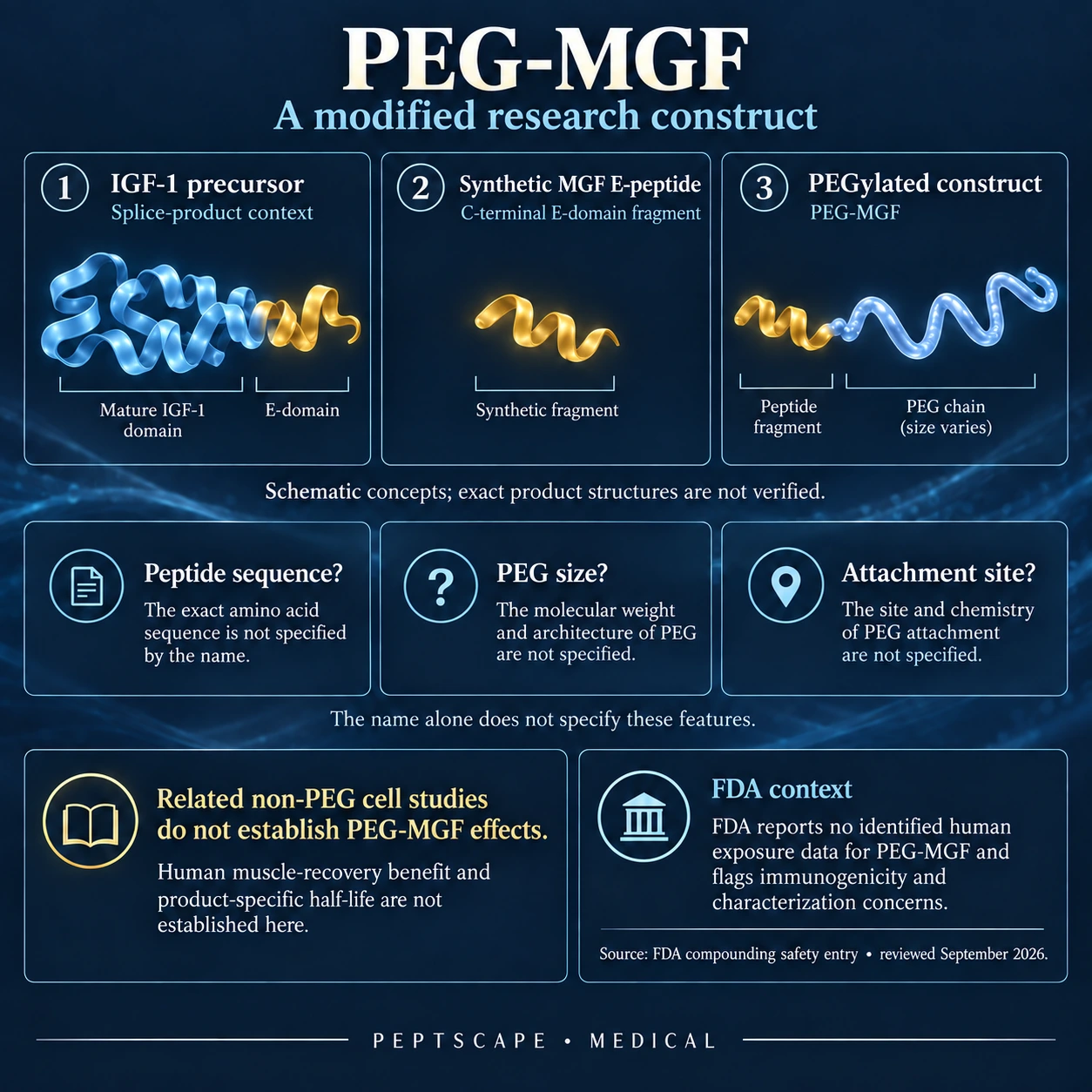
Educational illustration · Read the evidence and limitations below.
Evidence in perspective
PEG size, attachment and parent sequence change the substance. Related non-PEG cell experiments cannot establish a PEG-MGF product’s identity, human PK or muscle-building benefit.
About this assessment
Existing source snapshot critically reassessed.
Based on the selected source scope described in this profile, often an indexed abstract. Full methods and clinician sign-off remain pending; no systematic-review claim.
Related nonclinical MGF experiments, including rat cardiac cells and human/mouse muscle cells. These are not human PEG-MGF treatment trials.
What the sources found
A 2009 rat-cell study reported synthetic MGF E-peptide activity. A 2014 study did not reproduce proposed proliferation/differentiation effects in the muscle-cell systems it tested. Neither establishes clinical benefit for a verified PEG-MGF product.
Regulatory scope
US: FDA lists PEG-MGF among withdrawn compounding nominations with safety concerns. Withdrawal does not establish approval or safe use. Other jurisdictions were not reviewed.
What remains unknown
No exact PEG-MGF construct with matched human PK, effectiveness or product stability was verified. The two cited experimental studies examine related MGF biology, not interchangeable product evidence. This is an identity/evidence-gap snapshot, not a clinical review.
How it works
MGF-related research construct; native splice-variant biology does not establish the activity of a PEGylated product.
MGF research distinguishes full-length IGF-1 splice products from short E-peptides. A 2014 study failed to reproduce several claimed E-peptide effects in human and mouse muscle cells. It did not validate the effects of a commercial PEG-MGF formulation.
MGF E-peptides and IGF-1 controls; exact PEG-MGF product not tested.
Human adverse-event rates are unknown. FDA flags possible immunogenicity, impurities and characterization concerns; absence of exposure data cannot establish tolerability.
Contraindications
A validated product-specific contraindication and interaction list was not established by this review. Missing safety information does not mean there are no risks.
Preclinical research
The catalog primarily cites laboratory or animal research. Human benefit, a safe dose and long-term risks cannot be inferred from those findings.
MGF research distinguishes full-length IGF-1 splice products from short E-peptides. A 2014 study failed to reproduce several claimed E-peptide effects in human and mouse muscle cells. It did not validate the effects of a commercial PEG-MGF formulation.
MGF E-peptides and IGF-1 controls; exact PEG-MGF product not tested.
No verified human PEG-MGF regimen was identified in this pass. FDA reports no identified human exposure data for PEG-MGF by any route. Post-workout, near-muscle and alternate-day schedules are not established by the cited sources.
FDA exposure-data gap; not proof no future study could exist.
Fornaro M, Hinken AC, Needle S, Hu E, Trendelenburg AU, Mayer A, Rosenstiel A, Chang C, Meier V, Billin AN, Becherer JD, Brace AD, Evans WJ, Glass DJ, Russell AJ. Mechano-growth factor peptide, the COOH terminus of unprocessed insulin-like growth factor 1, has no apparent effect on myoblasts or primary muscle stem cells. 2014.
Stavropoulou A, Halapas A, Sourla A, Philippou A, Papageorgiou E, Papalois A, Koutsilieris M. IGF-1 expression in infarcted myocardium and MGF E peptide actions in rat cardiomyocytes in vitro. 2009.