Identity
PE 22-28 is a seven-residue spadin-derived research peptide studied at the TREK-1 channel.
Source-specific finding, not full clinical sign-off.
Peptide library
Your guide to this compound.
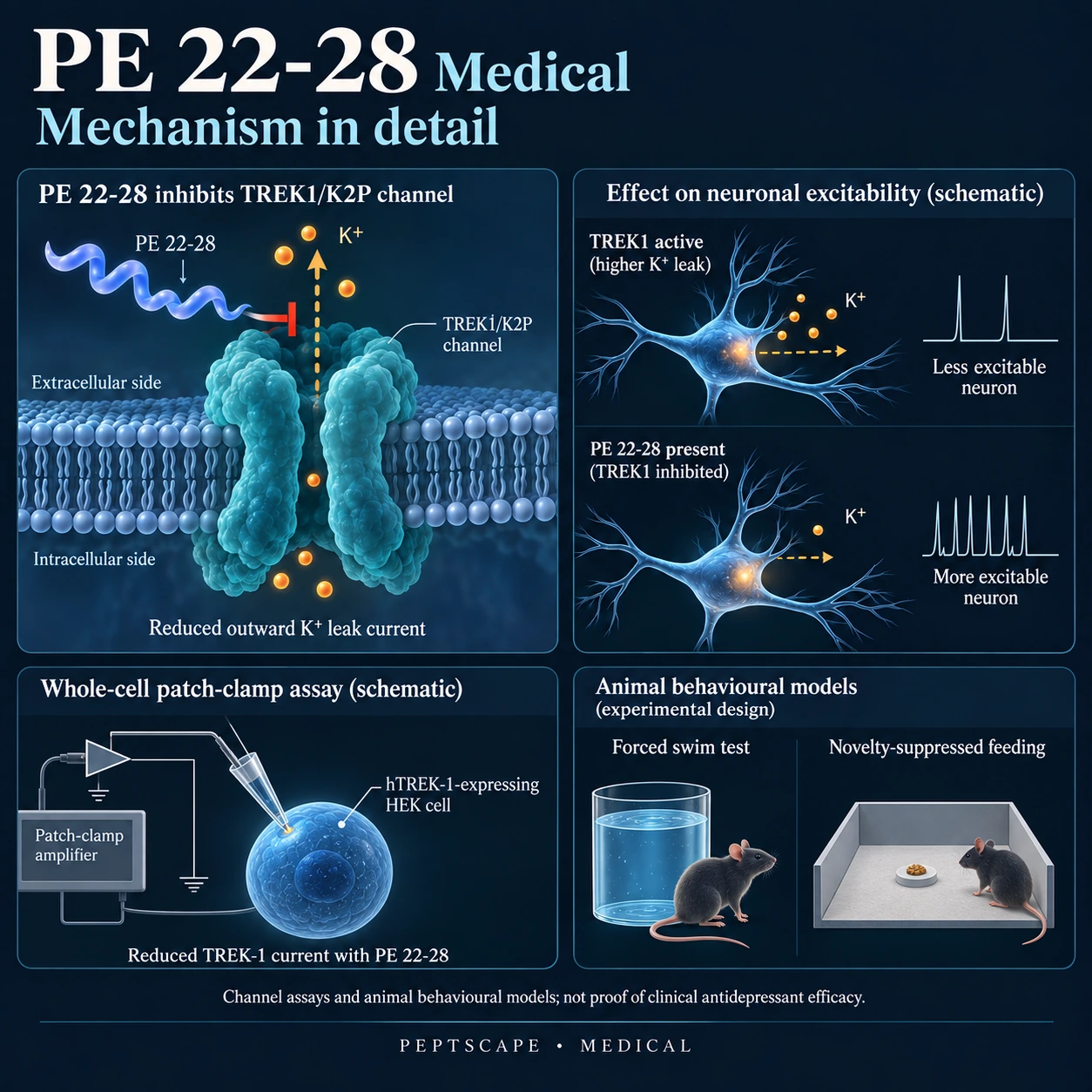
TREK-1 inhibition and mouse behavioral tests support a preclinical antidepressant hypothesis. Animal test performance is not a human depression outcome or a comparative clinical safety assessment.
Existing source snapshot critically reassessed.
Based on the selected source scope described in this profile, often an indexed abstract. Full methods and clinician sign-off remain pending; no systematic-review claim.
Editorial assessment · 2026-09-07
Engineered cells, mouse neurons and mouse behavioral models.
The study reported channel inhibition and antidepressant-like behavioral effects in mice; human antidepressant efficacy was not tested.
Current authorization must be checked for the exact product, indication and jurisdiction.
Limited selected-source check, not an exhaustive review. Full methods, complete safety, exact formulation/route pharmacokinetics, stability and current jurisdictional authorization remain outstanding.
PE 22-28 is a seven-residue spadin-derived research peptide studied at the TREK-1 channel.
Read the source-specific findings; biological activity is not equivalent to a clinical treatment benefit.
The catalog primarily cites laboratory or animal research. Human benefit, a safe dose and long-term risks cannot be inferred from those findings.
Source-specific finding, not full clinical sign-off.
The catalog primarily cites laboratory or animal research. Human benefit, a safe dose and long-term risks cannot be inferred from those findings.
PE 22-28 is a seven-residue spadin-derived research peptide studied at the TREK-1 channel.
Source-specific finding, not full clinical sign-off.
The study reported channel inhibition and antidepressant-like behavioral effects in mice; human antidepressant efficacy was not tested.
Source-specific finding, not full clinical sign-off.
The reported duration of action in mice is not a human elimination half-life or a safety assessment.
Source-specific finding, not full clinical sign-off.
Shortened Spadin Analogs Display Better TREK-1 Inhibition, <i>In Vivo</i> Stability and Antidepressant Activity. 2017.
PMID: 28955242
Catalog review date: Sep 7, 2026. This date alone does not establish independent clinical review.