Educational illustration · Read the evidence and limitations below.
What is Sterile Water for Injection?
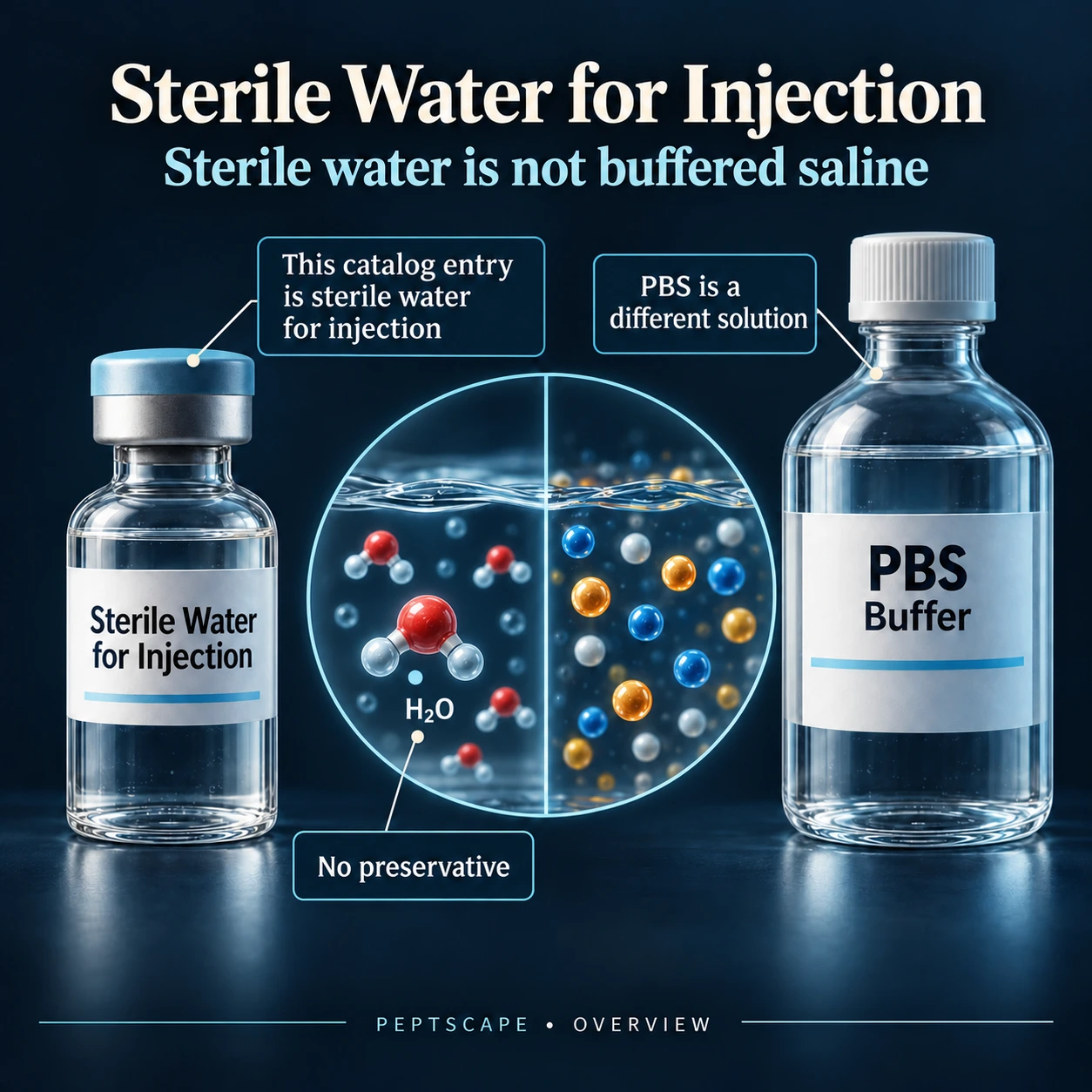
This entry concerns sterile water for injection, not phosphate-buffered saline despite the historical catalog identifier. Sterile water for injection contains no bacteriostatic preservative. It is also different from saline, which contains dissolved salt, and from ordinary purified or distilled water.
The wider picture
A preparation liquid has a specific job: it dissolves or dilutes a medicine into the formulation intended for use. It is not an active peptide, and changing the liquid can change acidity, preservative exposure and stability. Clear appearance alone does not show that a solution is compatible with a particular compound or suitable for an intended route.
Lyophilised means freeze-dried. Removing water can help a preparation remain stable before use, but it does not guarantee the stability of the solution after reconstitution. The unopened expiry date and the after-mixing discard date answer different questions and should be recorded separately.
What it is used for
It is used when the specified medicine calls for this diluent. A preservative-free single-dose container should not be treated like a multidose bacteriostatic-water vial. Plain sterile water is not intended to be injected alone intravenously in arbitrary amounts; tonicity and the final medicinal formulation matter.
Understanding the intended benefit
Reconstitution means adding a specified liquid to lyophilised material. Dilution means lowering the concentration of an existing solution. These are related but different steps. The final concentration depends on the total active amount and final volume; it does not determine which liquid is compatible or how long the prepared material can be kept.
A syringe's markings describe volume according to its design. They do not identify the amount of every medicine placed inside it. Concentration connects volume to active amount, but it cannot determine the correct dose or repair uncertainty about which diluent was used. The name, strength and final volume all belong in the preparation record.
How it works
Water provides the solvent, but it does not supply a buffering system or a preservative. Adding it changes concentration without automatically establishing stability or an after-mixing storage period. The exact receiving medicine determines whether sterile water is suitable, how much is used and what to do with unused material.
The biology in plain language
Keep the container label, opening date and preparation instructions together. Single-use and multidose containers have different handling requirements. A preservative helps control certain contamination risks during appropriate use; it does not sterilise a contaminated vial. Do not substitute household, drinking or laboratory water for an injectable diluent. Product-specific instructions take precedence over a generic mixing chart, including instructions about storage and discarding unused material.
An intact seal, appropriate storage and clean handling reduce avoidable problems but do not replace product quality controls. Unexpected particles, a damaged closure or an uncertain handling history need assessment. Heating, filtering or adding preservative at home is not a dependable way to rescue a questionable preparation.