Identity
NAD+ is a cellular cofactor, not a peptide. NAD+ and nicotinamide riboside are different substances.
Source-specific finding, not full clinical sign-off.
Peptide library
Your guide to this compound.
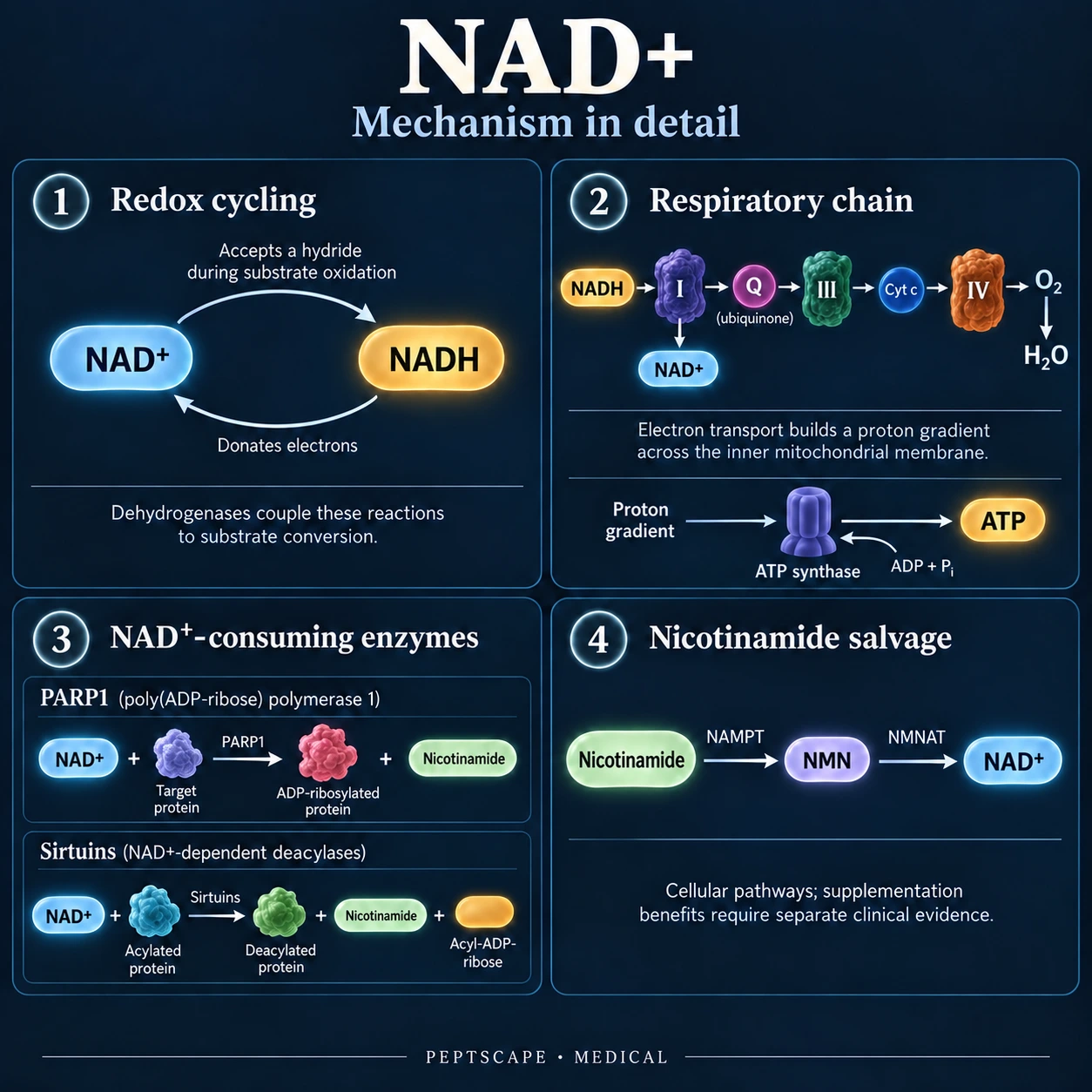
Retrospective commercial-infusion records permit exploratory tolerability comparisons, not randomized causal conclusions. Selection, product differences and short follow-up prevent claims of lifespan extension or comprehensive IV safety.
Selected full-text methods/results or correction sections assessed.
This assessment covers selected sources and sections. It is not a systematic review, formal risk-of-bias score, or clinician sign-off.
Editorial assessment · 2026-09-07
Retrospective commercial-infusion records; short pilot follow-up.
The study assessed infusion tolerability and exploratory laboratory measures, not lifespan extension or prevention of aging-related disease.
Current authorization must be checked for the exact product, indication and jurisdiction.
Limited selected-source check, not an exhaustive review. Full methods, complete safety, exact formulation/route pharmacokinetics, stability and current jurisdictional authorization remain outstanding.
NAD+ is a cellular cofactor, not a peptide. NAD+ and nicotinamide riboside are different substances.
Read the source-specific findings; biological activity is not equivalent to a clinical treatment benefit.
The catalog describes a limited clinical evidence base. Small or uncontrolled studies may not separate treatment effects from chance, placebo effects or bias.
Source-specific finding, not full clinical sign-off.
The catalog describes a limited clinical evidence base. Small or uncontrolled studies may not separate treatment effects from chance, placebo effects or bias.
NAD+ is a cellular cofactor, not a peptide. NAD+ and nicotinamide riboside are different substances.
Source-specific finding, not full clinical sign-off.
The study assessed infusion tolerability and exploratory laboratory measures, not lifespan extension or prevention of aging-related disease.
Source-specific finding, not full clinical sign-off.
NAD+ recipients reported gastrointestinal symptoms, increased heart rate and chest pressure during infusion.
Source-specific finding, not full clinical sign-off.
Intravenous infusion of nicotinamide adenine dinucleotide (NAD<sup>+</sup>) versus nicotinamide riboside (NR): a retrospective tolerability pilot study in a real-world setting. 2026.
PMID: 41704678
Catalog review date: Sep 7, 2026. This date alone does not establish independent clinical review.