Educational illustration · Read the evidence and limitations below.
Evidence in perspective
Acetylation changed behavior in chemical and cell assays. This is not a clinical comparison with Semax, and an amidated derivative is another identity again. Superior nasal performance remains unestablished.
About this assessment
Existing source snapshot critically reassessed.
Based on the selected source scope described in this profile, often an indexed abstract. Full methods and clinician sign-off remain pending; no systematic-review claim.
Chemical assays and cultured SH-SY5Y cells in the selected 2016 study.
What the sources found
Acetylation changed metal-related activity in a laboratory model; a superior human nootropic or longer-lasting nasal product was not demonstrated.
Regulatory scope
No product-specific authorization was verified here. Clinical use or authorization of parent Semax, where applicable, does not establish authorization of either acetylated form; jurisdictional review remains open.
What remains unknown
The selected primary abstract and chemical records do not establish the terminal identity of every sold product. Full methods, human trials, PK and stability remain unverified.
How it works
N-terminal modification can change activity; an improved nootropic profile has not been established.
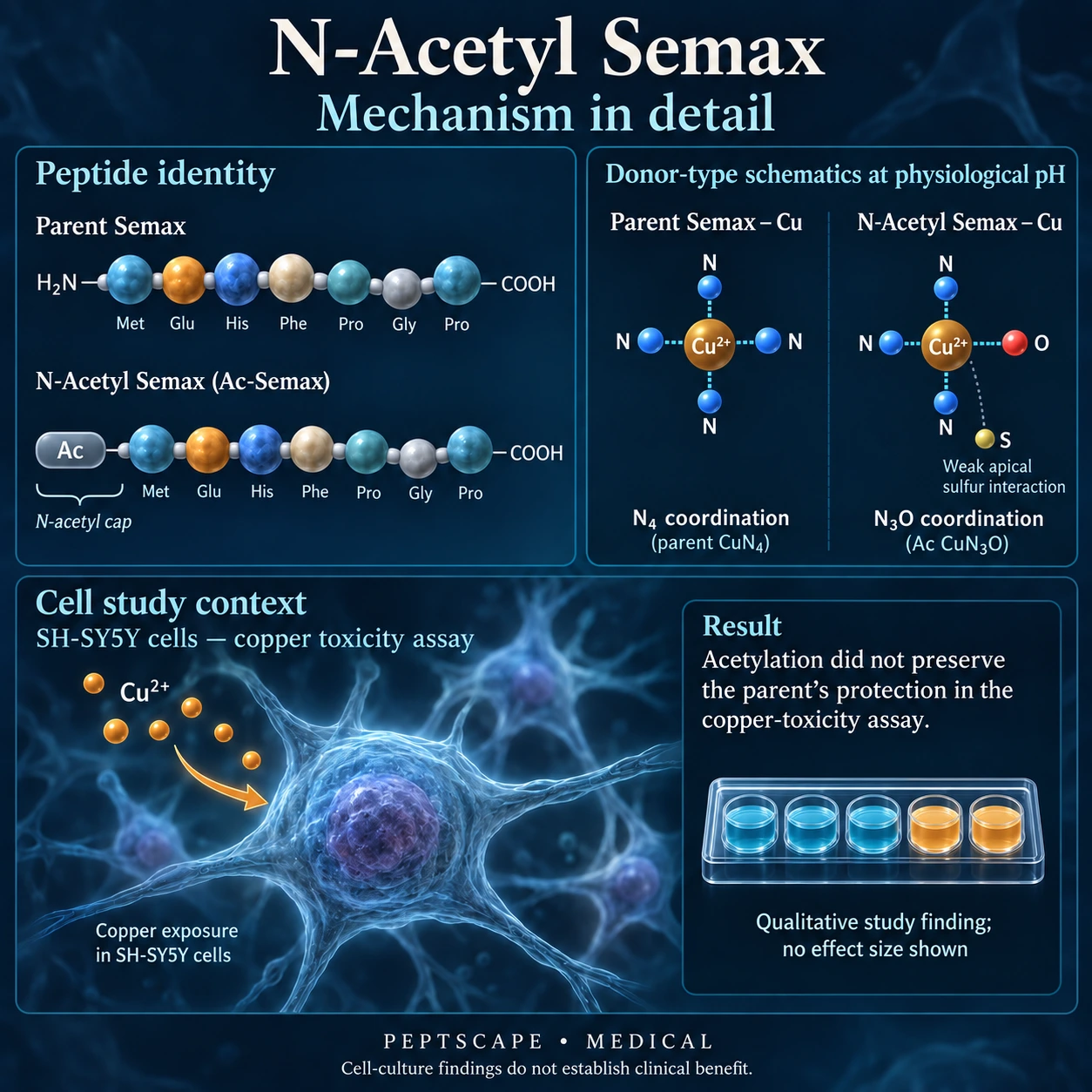
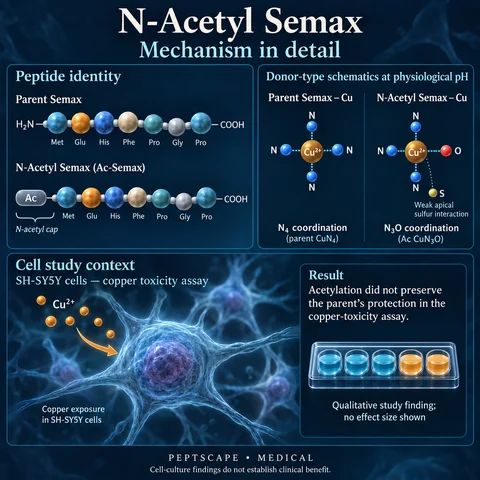
A 2016 Ac-Semax study examined metal coordination and cultured SH-SY5Y cells. The acetylated material did not preserve Semax’s protection against copper-induced toxicity in that model. This is not a human toxicity or cognition trial.
Laboratory material; not human effects or every amidate product.
Human adverse-event rates for the exact derivative and formulation were not verified. Parent-compound reports cannot establish its tolerability.
Contraindications
A complete product-specific contraindication and interaction assessment remains unavailable in this review. Missing evidence does not establish safety, including during pregnancy or breastfeeding.
Preclinical research
The catalog primarily cites laboratory or animal research. Human benefit, a safe dose and long-term risks cannot be inferred from those findings.
N-Acetyl Semax adds an acetyl group to the N-terminus of Semax. The free-acid form and the additionally C-terminally amidated form have different chemical records. The name alone must not silently substitute an amidate for the free acid.
Chemical structure distinction, not clinical benefit.
A 2016 Ac-Semax study examined metal coordination and cultured SH-SY5Y cells. The acetylated material did not preserve Semax’s protection against copper-induced toxicity in that model. This is not a human toxicity or cognition trial.
Laboratory material; not human effects or every amidate product.
Magrì A, Tabbì G, Giuffrida A, Pappalardo G, Satriano C, Naletova I, Nicoletti VG, Attanasio F. Influence of the N-terminus acetylation of Semax, a synthetic analog of ACTH(4-10), on copper(II) and zinc(II) coordination and biological properties. 2016.