Educational illustration · Read the evidence and limitations below.
Evidence in perspective
A chemical database entry can describe a proposed structure but cannot establish clinical benefit. The parent Selank experiments do not validate an N-acetyl product, enhanced brain delivery or longer human persistence.
About this assessment
Existing source snapshot critically reassessed.
Based on the selected source scope described in this profile, often an indexed abstract. Full methods and clinician sign-off remain pending; no systematic-review claim.
No matched study population located in the recorded search. Parent Selank serum-enzyme experiments are related context only.
What the sources found
No directly matching N-Acetyl Selank study was returned by the recorded Europe PMC term search. This is a search limitation, not proof that no study exists.
Regulatory scope
No product-specific authorization was verified here. A chemical database entry or parent Selank use is not a marketing authorization for the acetylated derivative; jurisdictional review remains open.
What remains unknown
Search terms and date are retained in the review audit. Chemical indexing is not product verification, clinical evidence or authorization. Non-indexed and non-English sources may be missed.
How it works
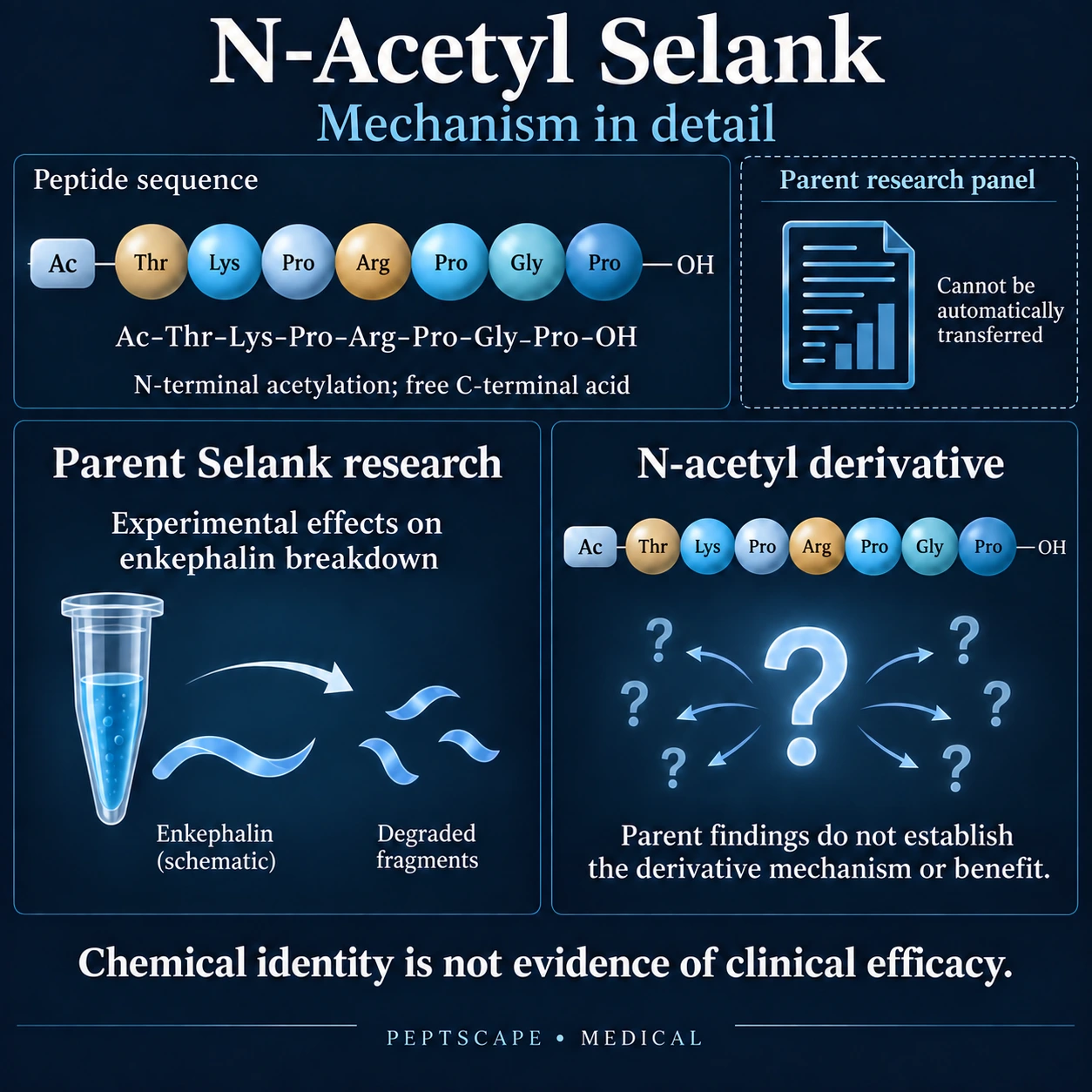
Derivative-specific pharmacology unverified; parent Selank results do not establish an acetylated product’s activity.
A 2001 laboratory study examined unmodified Selank and Semax with enzymes from human serum. It does not test N-Acetyl Selank or establish preserved GABA-related, immune or clinical effects after acetylation.
Related parent experiment only; not direct derivative evidence.
Human adverse-event rates for the exact derivative and formulation were not verified. Parent-compound reports cannot establish its tolerability.
Contraindications
A complete product-specific contraindication and interaction assessment remains unavailable in this review. Missing evidence does not establish safety, including during pregnancy or breastfeeding.
Anecdotal or unverified
Reports or marketing claims do not establish effectiveness or safety. Identity, formulation and claimed effects may need independent verification.
N-Acetyl Selank is an N-terminally acetylated Selank derivative. PubChem CID 133082488 describes a free C-terminal carboxylic acid. Additional C-terminal amidation would define a different structure; a parent Selank or acetate-salt label does not identify this modification.
Free-acid chemical record; no authentication of purchased material.
A 2001 laboratory study examined unmodified Selank and Semax with enzymes from human serum. It does not test N-Acetyl Selank or establish preserved GABA-related, immune or clinical effects after acetylation.
Related parent experiment only; not direct derivative evidence.