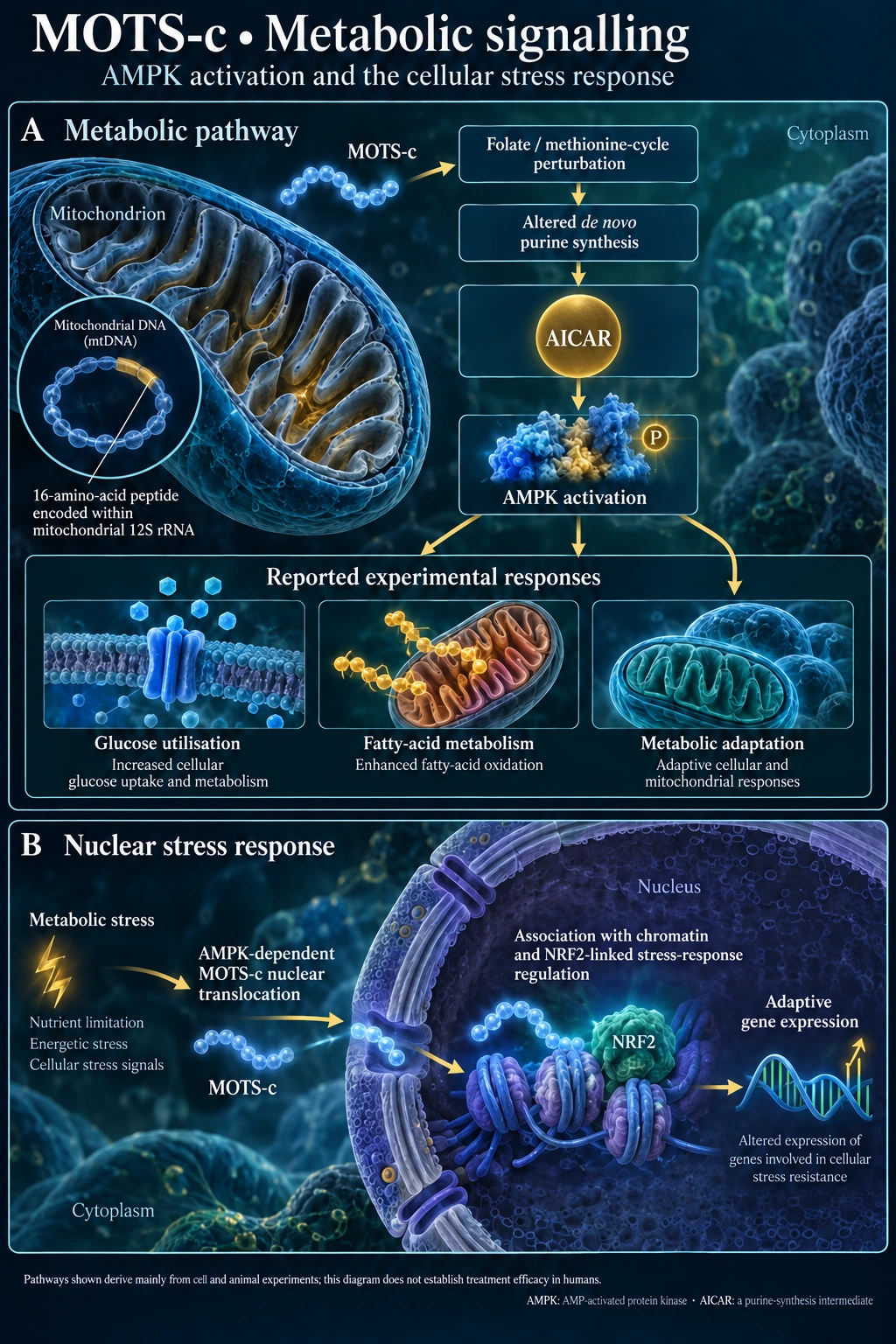
Educational illustration · Read the evidence and limitations below.
Medical · What is MOTS-c?
MOTS-c is a 16-amino-acid peptide linked to mitochondria, the structures inside cells that help turn fuel into usable energy. It belongs to a group of small signalling peptides associated with mitochondrial DNA.
Mitochondria do more than supply energy. They also participate in signals about cellular stress and fuel availability. MOTS-c is interesting because researchers have found links between this peptide, metabolic regulation and the body's response to exercise.
People usually investigate it for energy, insulin sensitivity, exercise capacity or healthy ageing. It is sometimes called “exercise in a molecule.” That phrase captures the research theme but overstates what an injection has been shown to do in people. Exercise trains the heart, muscles, balance, bones and many other systems; a single signal cannot be assumed to reproduce all of that.
A naturally occurring peptide and an externally administered preparation also answer different questions. Measuring the body's own MOTS-c after exercise is not a trial showing that injected MOTS-c improves human performance.
Medical · Benefits and common reasons for interest
Metabolic health
Early research found effects on metabolism and insulin sensitivity in experimental models. Insulin sensitivity describes how effectively cells respond to insulin's signal to manage glucose. This is one reason MOTS-c appears in discussions of weight and metabolic health.
It should not be treated as a replacement for established diabetes treatment. A mechanism involving glucose use does not establish a safe amount, predictable glucose reduction or benefit in someone taking other medicines.
Exercise capacity
Animal research has explored physical performance and age-related decline. Human research has also measured changes in naturally occurring MOTS-c around exercise. These are connected findings, but they are not the same intervention.
A person hoping to improve endurance should track a repeatable activity, recovery and symptoms. A single unusually good workout is not enough to identify a peptide effect, especially when training, carbohydrate intake or sleep changed too.
Fatigue and healthy ageing
Mitochondrial biology attracts interest because it is relevant to many age-related processes. However, ordinary fatigue is not a diagnosis of mitochondrial disease or MOTS-c deficiency.
Persistent exhaustion can come from sleep disorders, anaemia, thyroid disease, under-fuelling, infection and many other causes. An experimental peptide should not delay identifying a treatable reason for the symptom.
Medical · How does it work?
One research pathway involves AMPK, an enzyme system that helps cells respond to energy availability. When energy is limited, cells change how they use and store fuel. MOTS-c research has linked the peptide to this kind of metabolic adjustment.
Researchers have also studied how it influences cellular responses to stress. These findings are more specific than saying it “repairs mitochondria.” Mitochondrial number, energy production, stress signalling and exercise performance are different measurements.
A molecule can influence the same broad pathway as exercise or a medicine without producing the same whole-body result. This is why terms such as “exercise mimetic” are best understood as research descriptions rather than promises.
Medical · Natural MOTS-c and related research compounds
The body produces MOTS-c as part of its own biology. Observational measurements can show an association with age, exercise or metabolic status, but they do not establish that a low result should be corrected by injection.
Modified analogues studied in clinical development are separate compounds. A trial of an analogue cannot automatically establish the dose, half-life or effectiveness of ordinary MOTS-c.
Likewise, other mitochondrial peptides, including humanin and SS-31, have different structures and research histories. They are not interchangeable “mitochondrial support,” and combining them does not establish broader coverage or proven synergy.
Medical · Dosing and concentration
Online discussions often describe short cycles and repeated milligram amounts. A 5–10 mg, two-to-three-times-weekly pattern is circulated in wellness discussions. The foundational metabolic and exercise papers do not validate that as a human performance or longevity regimen.
Animal doses should not be converted into a self-directed human injection plan. Differences in metabolism, route, formulation and study purpose make a simple body-weight conversion inadequate.
Concentration can still be explained clearly. If an identified 10 mg preparation has a documented final volume of 2 mL, it contains 5 mg/mL. This is arithmetic, not an instruction to prepare or administer that product. A vial amount and an administration amount must remain separate.
Keep the exact compound and any analogue designation with the record. A schedule should reflect an actual clinical decision, not an assumed “mitochondrial cycle” generated from vial size.
Medical · Preparation and reconstitution
Lyophilised MOTS-c is freeze-dried material. Reconstitution means adding a suitable liquid, but dissolving it does not establish human-use quality, correct identity or sterility.
Bacteriostatic water is commonly mentioned in peptide preparation discussions. Its preservative does not prove that MOTS-c remains stable in that solution or that an experimental vial is safe for injection. Diluent, final concentration, container and usable period need formulation-specific support.
For a medically supplied preparation, retain the exact written instructions and use clean preparation conditions with sterile single-use equipment. Do not substitute another water type, heat the vial or add other peptides to create a blend without compatibility information.
Record the total amount, final volume, preparation date and storage limit. If documentation cannot establish the intended human-use formulation, a calculator cannot supply the missing quality information.
Medical · Administration
The experimental studies use defined routes and preparations. They do not establish that an online subcutaneous schedule reproduces the animal results or that injecting into a particular muscle improves its energy production.
Subcutaneous means the fatty layer beneath the skin. For any prescribed injectable preparation, technique and site should be taught for that device and person. Rotate appropriate sites, avoid damaged skin and use new sterile equipment for every administration.
Do not take a sudden burst of energy, flushing or discomfort as a reason to increase the amount. Record symptoms and the activity performed. New chest pain, fainting, severe breathlessness or a severe allergic reaction requires urgent assessment.
Medical · Routes and bioavailability
Oral peptides encounter digestion before reaching the intestinal barrier. Subcutaneous administration avoids that first step but does not establish a human performance benefit or a known percentage of absorption for MOTS-c.
A product described as liposomal, sublingual or nasal still needs evidence for that formulation. Those labels do not by themselves supply a conversion from an injection amount.
Local gut action explains why some oral peptide medicines can be useful despite little bloodstream exposure. The main MOTS-c research concerns metabolic signalling; poor absorption is not established as a special gut-targeting advantage for this peptide.
Medical · Half-life
A dependable human elimination half-life for administered MOTS-c has not been established by the sources used here. Animal measurements and values from modified analogues should not be presented as a human MOTS-c number.
A cellular effect lasting longer than blood exposure does not establish how many days an injection “works.” Half-life cannot currently justify a standard cycle in this profile.
Medical · Storage
Use the actual preparation's specified temperature and after-mixing limit. A universal 30-day refrigerated shelf life is not demonstrated by the peptide name or by using bacteriostatic water.
Keep the lyophilised expiry separate from the mixed-solution discard date. Protect the container as directed and record heat exposure or an interrupted cold chain. Do not freeze and thaw repeatedly without explicit formulation guidance.
A clear solution is not a sterility test. Unexpected particles, a broken seal or an uncertain handling history needs assessment rather than filtering, topping up or transferring the material.
Medical · Contraindications and side effects
Human treatment data are too limited to define a complete side-effect pattern. This makes it particularly important not to describe MOTS-c as side-effect-free merely because the body produces it naturally.
People using insulin or other glucose-lowering treatment need medical review before adding an experimental metabolic intervention. Symptoms such as sweating, shaking, confusion or marked weakness need appropriate assessment; they are not evidence of a desirable metabolic switch.
Pregnancy, breastfeeding, children, significant liver or kidney disease and unexplained fatigue call for a medical evaluation rather than a self-directed protocol. Injection-related infection and immune reactions remain concerns independent of the proposed metabolic mechanism.
Medical · Nutrition and supplement support
Fuel activity rather than chasing a pathway
Exercise performance depends on enough energy, appropriate carbohydrate availability, protein and hydration. A person training hard while under-eating may feel worse regardless of how many mitochondrial supplements are added.
Use regular meals and an activity-appropriate intake. If body composition is the goal, avoid judging success only by the scale; strength, waist, recovery and the sustainability of the eating pattern matter too.
Protein and creatine
Protein supports tissue maintenance and training recovery. Creatine can help repeated high-intensity performance in appropriate adults. Neither has a demonstrated MOTS-c-specific synergy, and creatine is not a substitute for aerobic training.
Record supplement introduction separately from peptide exposure. If performance improves after starting a training programme, eating more and adding creatine, the peptide cannot be credited automatically.
B vitamins, iron and magnesium
These nutrients have roles in normal metabolism. Deficiencies can contribute to fatigue or impaired function, but extra intake does not necessarily increase cellular energy when needs are already met.
Iron supplementation should follow a reason to suspect or identify deficiency. Excess iron can be harmful. High-dose B-complex products may also provide unnecessarily large vitamin B6 amounts. Magnesium supplements need care with kidney disease and can cause digestive effects.
CoQ10, NAD-related products and antioxidants
These are often grouped with MOTS-c because all are discussed in relation to energy metabolism. That thematic connection does not establish a beneficial combination. Evidence depends on the product and medical condition; “mitochondrial support” is not a single measurable treatment outcome.
Avoid stacking several new products at once. Concentrated antioxidants and glucose-related supplements can have their own interactions. A clear purpose, dose record and review point is more useful than assuming each extra ingredient fills another part of a pathway.
Medical · Tracking progress and everyday questions
Choose a repeatable measure such as a standard walk, cycling effort or resistance-training session. Keep conditions similar and record sleep, illness, food intake and perceived exertion. Stop exercise and seek assessment for concerning symptoms rather than using a performance target to override them.
Does MOTS-c replace exercise? No. Does a natural decline with age prove replacement is beneficial? No. Is an analogue's clinical trial a trial of ordinary MOTS-c? No; exact identity matters.
Persistent fatigue deserves investigation even if an experimental product temporarily changes how someone feels.
Medical · Medical
The 2015 work established important metabolic findings in experimental models. The 2021 exercise paper combined animal intervention findings with measurements of endogenous MOTS-c around exercise in a small human group. The human component was not a trial of injected MOTS-c as a performance treatment.
This distinction preserves the actual positive research without turning it into a human dosing claim. MOTS-c does not have an FDA-approved medicinal indication.