Educational illustration · Read the evidence and limitations below.
What is MID-35?
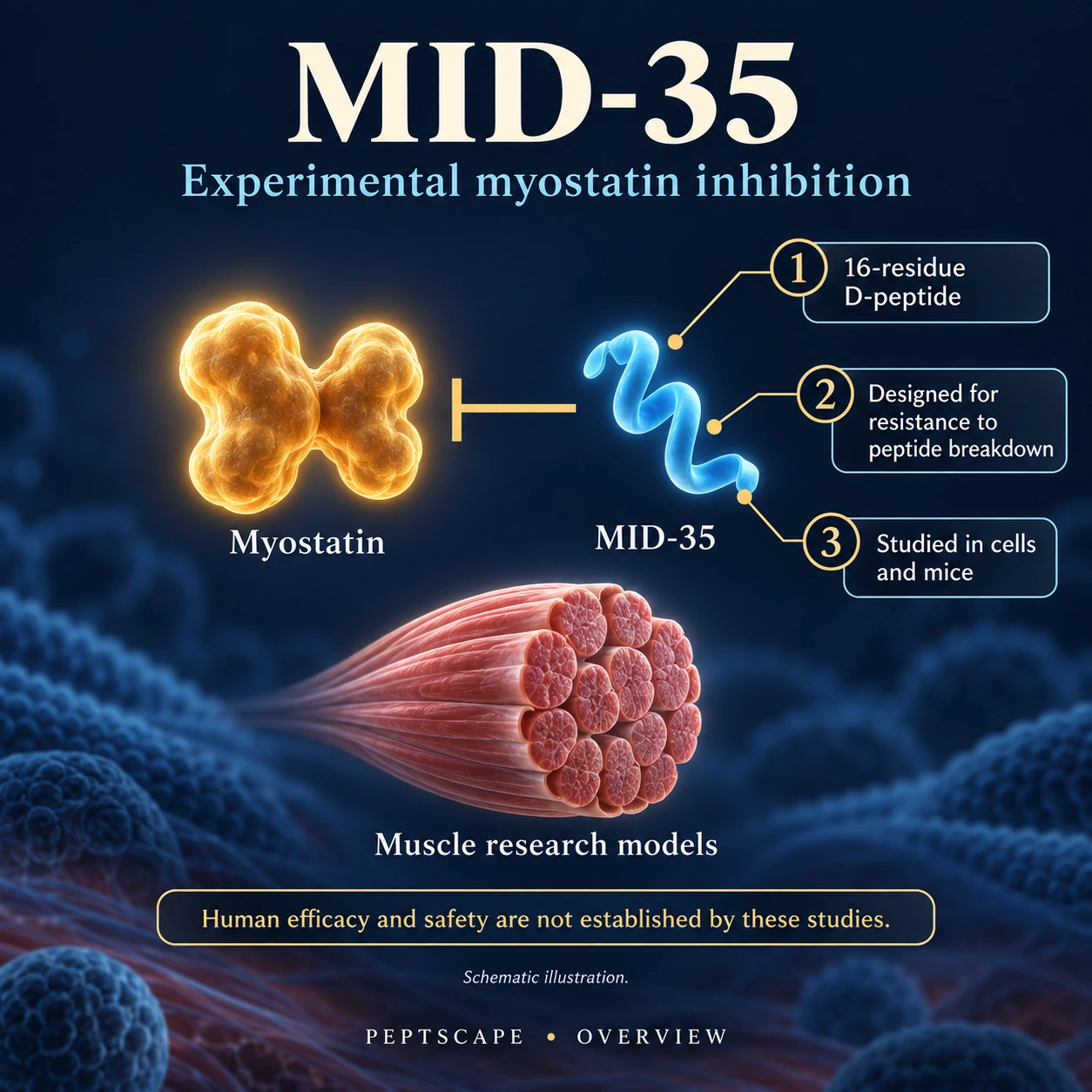
MID-35 is an experimental D-peptide designed to inhibit myostatin, one of the signals that restrains muscle growth. It is a defined research approach distinct from follistatin, an activin-receptor fusion protein or an unspecified blend. The D designation refers to the type of amino-acid building blocks used in its design.
The wider picture
Muscle size, strength and function are related but different. A larger muscle may not produce a proportional increase in useful force, and improved force does not guarantee that a tendon or joint can tolerate a heavier load. Muscle also contains water, blood vessels, connective tissue and stored fuel. An increase in lean mass is therefore not a direct count of new contractile muscle fibres.
Training stimulates adaptation through repeated loading and recovery. Muscle can adapt faster than some supporting connective tissues, so a rapid increase in size or force can create a mismatch with what a tendon tolerates. A sensible assessment includes the quality of movement and the response after exercise, not just the amount lifted on the strongest day.
What it is used for
The intended application is preservation or growth of skeletal muscle. It remains important to separate muscle size from strength and practical function. Delivery is also a central research question: results involving a specialised skin-delivery method or local exposure cannot be turned into a standard consumer injection schedule.
Understanding the intended benefit
The muscle-growth pathway is relevant to both muscle-wasting disorders and body-composition goals, but these are different settings. A treatment developed for a specific muscle disease does not automatically become a general training aid. Useful outcomes include getting out of a chair, walking, lifting a repeatable load and recovering from activity. Those outcomes need to be considered alongside changes in swelling, pain and exercise tolerance.
Loss of muscle can accompany inactivity, inadequate intake, ageing, nerve disease and many other conditions. These causes do not all respond to the same growth signal. The reason for muscle loss helps determine whether the priority is rehabilitation, nutritional replacement, treatment of an underlying disease or a specialised therapy. A pathway name alone cannot make that distinction.
How it works
The peptide is designed to interfere with myostatin-related signalling. D-amino-acid designs can alter resistance to breakdown, but they do not establish a particular human half-life or prove that every tissue is spared. MID-35's identity should remain separate from FLGR-242 descriptions rather than being used to fill gaps in another product's documentation.
The biology in plain language
Growth signals work within a network. Some encourage tissue growth; others help limit it. Removing a growth-limiting signal is different from adding a growth-promoting one, and neither action is necessarily confined to skeletal muscle. Similar pathways also contribute to blood vessels, reproduction and tissue repair. The precise protein or peptide matters: a gene-delivery construct, a purified protein and a short fragment are different interventions even if all are described using the same pathway name.
Protein provides amino acids for tissue maintenance, but a growth factor is a signal rather than a large source of dietary protein. Giving a stronger signal cannot compensate indefinitely for inadequate food or inappropriate loading. Likewise, a protein supplement cannot recreate the specific receptor action of a peptide. Keeping these roles separate makes both the nutrition discussion and the peptide explanation clearer.