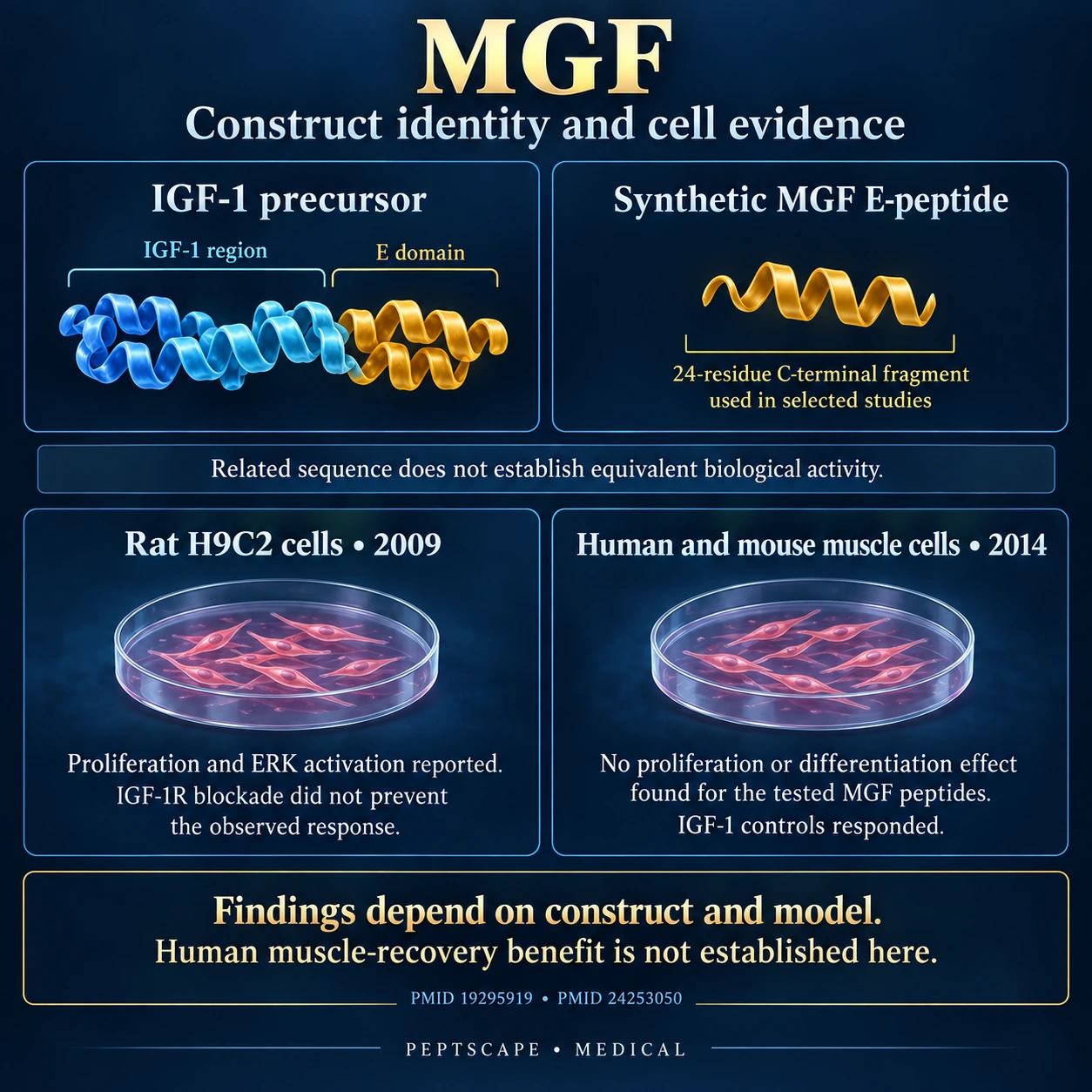
Educational illustration · Read the evidence and limitations below.
Evidence in perspective
Conflicting cell experiments make the proposed mechanism uncertain. Synthetic E-peptide, an endogenous splice product and a commercial MGF vial must not be treated as one verified intervention.
About this assessment
Existing source snapshot critically reassessed.
Based on the selected source scope described in this profile, often an indexed abstract. Full methods and clinician sign-off remain pending; no systematic-review claim.
Related cell experiments, not a human treatment population.
What the sources found
Earlier rat cardiac-cell findings and a later negative muscle-cell replication leave the proposed repair mechanism unsettled.
Regulatory scope
A product-specific authorization was not verified in this pass. Full jurisdictional review remains outstanding; PEG-MGF regulatory statements are not automatically applied to non-PEG MGF.
What remains unknown
Selected primary abstracts reviewed. Exact commercial constructs, complete study methods, human exposure and product stability remain unverified.
How it works
MGF E-peptide activity is disputed; splice-product expression is not proof of an injected peptide effect.
A 2014 study tested MGF peptides in human and mouse muscle-cell systems and found no effect on proliferation or differentiation, while IGF-1 controls responded. This challenges the claim that the isolated E-peptide reliably activates muscle stem cells.
In-vitro findings, not clinical ineffectiveness in all settings.
Human adverse-event rates for the exact derivative and formulation were not verified. Parent-compound reports cannot establish its tolerability.
Contraindications
A complete product-specific contraindication and interaction assessment remains unavailable in this review. Missing evidence does not establish safety, including during pregnancy or breastfeeding.
Preclinical research
The catalog primarily cites laboratory or animal research. Human benefit, a safe dose and long-term risks cannot be inferred from those findings.
MGF is used for both an IGF-1 splice-product context and a short synthetic E-peptide derived from its C-terminal region. These are different experimental materials. An MGF vial label alone does not identify the sequence, terminal modifications or equivalence to a full-length IGF-1 precursor.
Experimental materials must be distinguished; commercial identity is an unresolved gap.
A 2014 study tested MGF peptides in human and mouse muscle-cell systems and found no effect on proliferation or differentiation, while IGF-1 controls responded. This challenges the claim that the isolated E-peptide reliably activates muscle stem cells.
In-vitro findings, not clinical ineffectiveness in all settings.
A 2009 rat cardiac-cell experiment reported proliferation and ERK signaling with a synthetic MGF E-peptide. This was a cell finding, not demonstrated human muscle recovery.
Fornaro M, Hinken AC, Needle S, Hu E, Trendelenburg AU, Mayer A, Rosenstiel A, Chang C, Meier V, Billin AN, Becherer JD, Brace AD, Evans WJ, Glass DJ, Russell AJ. Mechano-growth factor peptide, the COOH terminus of unprocessed insulin-like growth factor 1, has no apparent effect on myoblasts or primary muscle stem cells. 2014.
Stavropoulou A, Halapas A, Sourla A, Philippou A, Papageorgiou E, Papalois A, Koutsilieris M. IGF-1 expression in infarcted myocardium and MGF E peptide actions in rat cardiomyocytes in vitro. 2009.