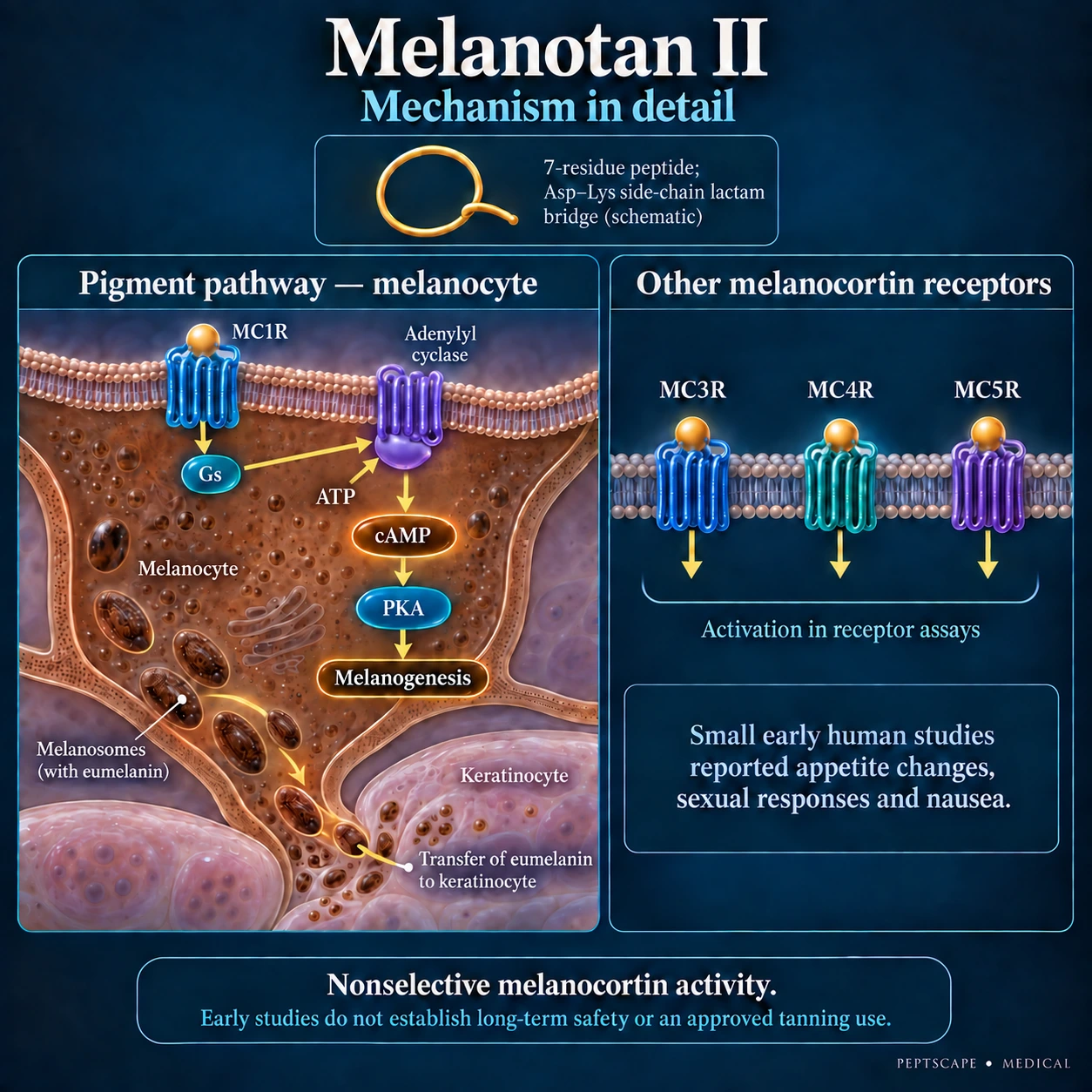
Educational illustration · Read the evidence and limitations below.
Evidence in perspective
Very small human pigmentation and erectile-response studies are not long-term safety evidence. Pigmentation is not proof of ultraviolet protection; related afamelanotide approval does not authorize this molecule.
About this assessment
Existing source snapshot critically reassessed.
Based on the selected source scope described in this profile, often an indexed abstract. Full methods and clinician sign-off remain pending; no systematic-review claim.
Very small historical studies of healthy men and men with psychogenic erectile dysfunction; no broad consumer tanning population established.
What the sources found
Early studies observed pigmentation and erectile responses alongside adverse effects. They do not establish long-term safety, a consumer tanning schedule or protection from ultraviolet radiation.
Regulatory scope
Australia: TGA states that melanotan is not approved as a tanning agent and does not replace sunscreen protection. US: FDA lists Melanotan II among withdrawn compounding nominations with safety concerns. Approval of another melanocortin product is not approval of Melanotan II.
What remains unknown
Selected abstracts and regulator warnings, not a full clinical review. Serious event reports need individual causality appraisal; no incidence estimate is assigned. Internet vial or nasal-spray identity, purity, PK and stability were not verified.
How it works
Melanocortin analogue with pigmentation and erectile effects in small early studies.
Its melanocortin activity can affect pigmentation and sexual responses. These pharmacological effects are not proof of a safe tanning method, UV protection or a validated sexual-health treatment.
Limited clinical evidence
The catalog describes a limited clinical evidence base. Small or uncontrolled studies may not separate treatment effects from chance, placebo effects or bias.
Early studies reported nausea, yawning/stretching, erections and, at higher pilot doses, somnolence or fatigue.
FDA cites serious case reports including melanoma, prolonged erection (priapism), sympathomimetic toxicity and posterior reversible encephalopathy syndrome. Case reports do not establish incidence or prove causality.
Very small escalating-dose pilot; no population incidence estimate.
A validated product-specific contraindication and interaction list was not established by this review. Missing safety information does not mean there are no risks.
Limited clinical evidence
The catalog describes a limited clinical evidence base. Small or uncontrolled studies may not separate treatment effects from chance, placebo effects or bias.
Melanotan II is a synthetic cyclic seven-amino-acid analogue of alpha-melanocyte-stimulating hormone. Small historical studies examined pigmentation and erections. It is a different compound from Melanotan I/afamelanotide and should not inherit that medicine’s product evidence.
Identity of studied MT-II; no equivalence to MT-I/afamelanotide.
A crossover study in ten men with psychogenic erectile dysfunction observed erections in eight after Melanotan II; this does not establish a routine treatment regimen.
Ten men with psychogenic erectile dysfunction; not a general libido claim.
FDA cites serious case reports including melanoma, prolonged erection (priapism), sympathomimetic toxicity and posterior reversible encephalopathy syndrome. Case reports do not establish incidence or prove causality.
Serious case reports, not demonstrated causality or event frequency.
Dorr RT, Lines R, Levine N, Brooks C, Xiang L, Hruby VJ, Hadley ME. Evaluation of melanotan-II, a superpotent cyclic melanotropic peptide in a pilot phase-I clinical study. 1996.