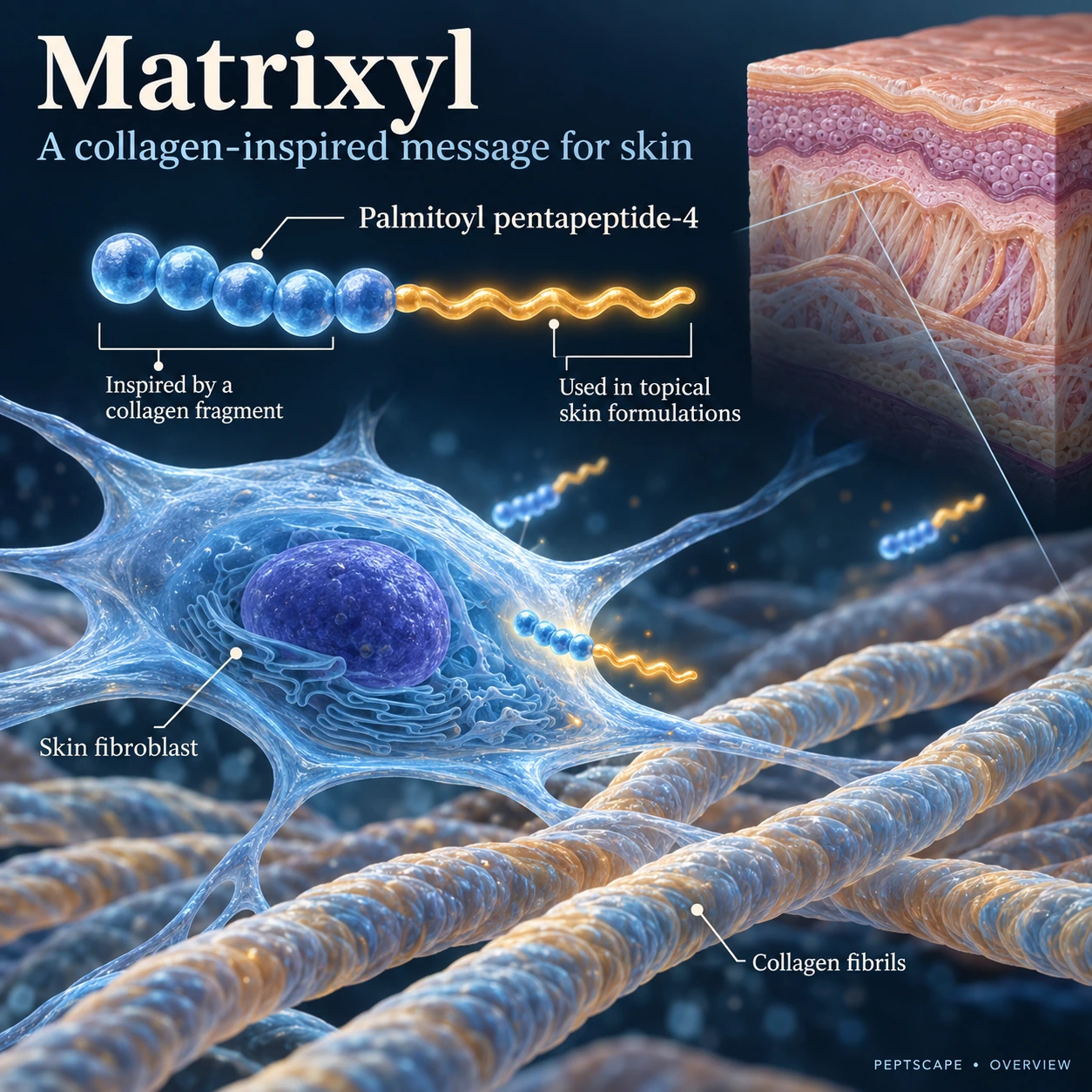
Educational illustration · Read the evidence and limitations below.
What is Matrixyl?
This entry concerns palmitoyl pentapeptide-4, a cosmetic peptide also known as pal-KTTKS and associated with the original Matrixyl ingredient. Other products using the Matrixyl name can contain different peptide combinations. The ingredient list is therefore more precise than the umbrella name.
The wider picture
Skin has several layers and jobs. The outer barrier limits water loss and helps protect against irritants. Deeper layers contain connective tissue, including collagen, that contributes to support and elasticity. A topical ingredient may change hydration, surface appearance or signalling in the skin. These effects should be distinguished from filling a wrinkle, relaxing an injected muscle or treating a diagnosed skin disease.
Fine surface lines, deeper folds, uneven pigment and loss of volume are different cosmetic concerns. A product improving one may have little effect on another. This is why a useful peptide explanation identifies the intended skin process rather than promising a generally younger face. The location of the concern also matters: delicate eyelid skin and a hair-bearing scalp are different environments.
What it is used for
The intended cosmetic use is improvement in the appearance of wrinkles and skin texture. It is generally encountered in finished topical formulations. The effect of a complete moisturiser includes its vehicle and other ingredients, so a result for one formula does not demonstrate the same performance for every product bearing a similar name.
Understanding the intended benefit
For a cosmetic goal, compare like with like: the same lighting, camera distance, facial expression and interval after applying products. Hydration can temporarily soften the appearance of fine lines, while changes in texture or pigment may take longer to assess. A new cleanser, exfoliant or moisturiser can also change the result. Introducing several active products together makes it harder to identify which product helped or caused irritation.
The skin barrier can become irritated when too many active products are added together. Acids, retinoids, fragrances and exfoliation may contribute to a reaction independently of a peptide. A simple routine and one change at a time make it easier to understand tolerance. A negative response should be recorded along with the complete product name, not just the highlighted peptide ingredient.
How it works
The peptide sequence is related to a fragment associated with collagen signalling, and the attached lipid group influences its formulation properties. A signal associated with the skin's repair environment is not the same as injecting structural collagen into a wrinkle. Topical use also does not establish a reason to inject the ingredient or combine it with injectable peptides.
The biology in plain language
The outer skin barrier strongly influences delivery. A peptide in a finished cream is not necessarily delivered in the same way as a solution containing that peptide alone. Concentration, vehicle, stability and the rest of the formulation matter. A topical cosmetic must not be converted into an injection. Redness, burning or persistent swelling is not proof of productive renewal; it is a reason to stop and assess the product and the skin condition.
Collagen is part of the tissue's structural framework, while water content contributes to surface softness and temporary plumping. These are different routes to an apparent improvement in a photograph. Sun protection and appropriate moisturising support the skin through their own established functions. Their value does not depend on a claimed synergy with a particular cosmetic peptide.