Educational illustration · Read the evidence and limitations below.
Evidence in perspective
The phase IIb venous-ulcer study did not show overall benefit. The favorable larger-ulcer subgroup was post hoc, and compression care was part of treatment. Another topical ulcer setting cannot validate systemic injection.
About this assessment
Selected full-text methods/results or correction sections assessed.
This assessment covers selected sources and sections. It is not a systematic review, formal risk-of-bias score, or clinician sign-off.
Patients with hard-to-heal venous leg ulcers receiving topical LL-37 plus compression; separately, a topical-cream trial in mildly infected diabetic foot ulcers.
What the sources found
The phase IIb venous-ulcer trial found no significant overall healing benefit versus placebo. A favorable large-ulcer subgroup result was post hoc and needs confirmation.
Entire trial cohort versus exploratory post hoc subgroup.
U.S.: FDA lists this substance among withdrawn compounding nominations with safety concerns; this does not establish approval.
What remains unknown
A separate diabetic-foot-ulcer study reported improved granulation but no significant reduction in the measured inflammatory markers or bacterial colonization. Different wounds and formulations cannot be pooled into a general treatment claim. Targeted source snapshot, not a full clinical review. Product stability, interactions and jurisdiction-specific authorization remain outstanding.
How it works
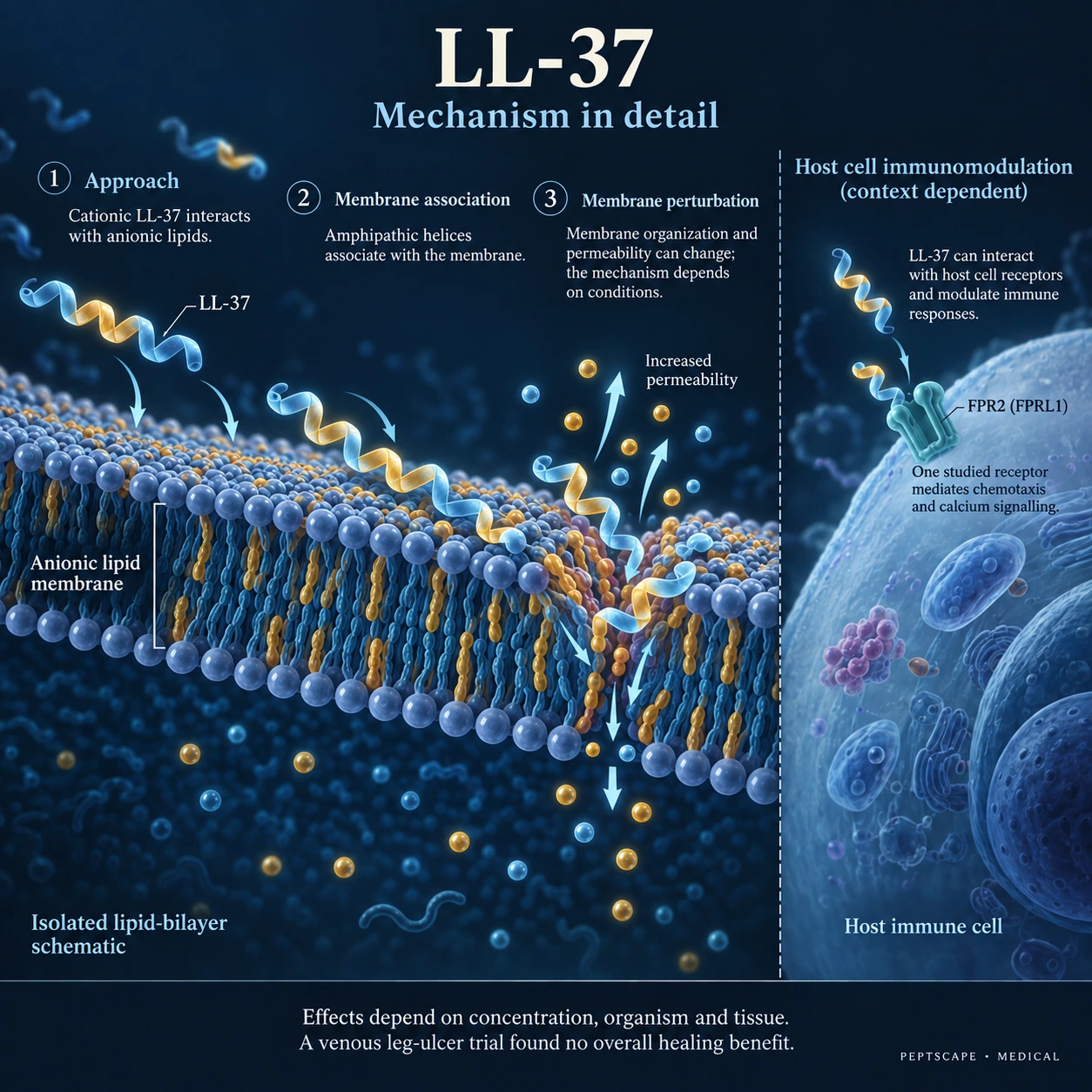
LL-37 is studied for local effects on wound repair and host defense. Biological antimicrobial activity alone does not demonstrate that a formulation treats an infection in patients.
LL-37 is studied for local effects on wound repair and host defense. Biological antimicrobial activity alone does not demonstrate that a formulation treats an infection in patients.
Human trials
This catalog identifies human research. A trial can be early, small or negative; its existence does not establish approval or benefit for every proposed use. Check the study population and outcomes.
A complete clinical contraindication and interaction profile has not been established in this review.
Human trials
This catalog identifies human research. A trial can be early, small or negative; its existence does not establish approval or benefit for every proposed use. Check the study population and outcomes.
LL-37 is a human cathelicidin peptide studied in immune biology and wound repair. Human trials have tested topical wound formulations; those trials do not validate injected LL-37 for infections.
Topical venous-ulcer trial; not systemic infection treatment.
The phase IIb venous-ulcer trial found no significant overall healing benefit versus placebo. A favorable large-ulcer subgroup result was post hoc and needs confirmation.
Entire trial cohort versus exploratory post hoc subgroup.
The phase IIb venous-ulcer trial found no significant overall healing benefit versus placebo. A favorable large-ulcer subgroup result was post hoc and needs confirmation.
Entire trial cohort versus exploratory post hoc subgroup.
A diabetic-foot-ulcer cream trial reported better granulation measures, without significant improvement in bacterial colonization or the measured inflammatory markers.
Topical cream for mildly infected diabetic foot ulcers; distinct formulation and population.
The venous-ulcer trial evaluated topical solutions at 0.5 or 1.6 mg/mL with compression. Concentration is not an injected dose; this does not establish a subcutaneous regimen.
Investigational topical formulation plus compression; not a self-use regimen.