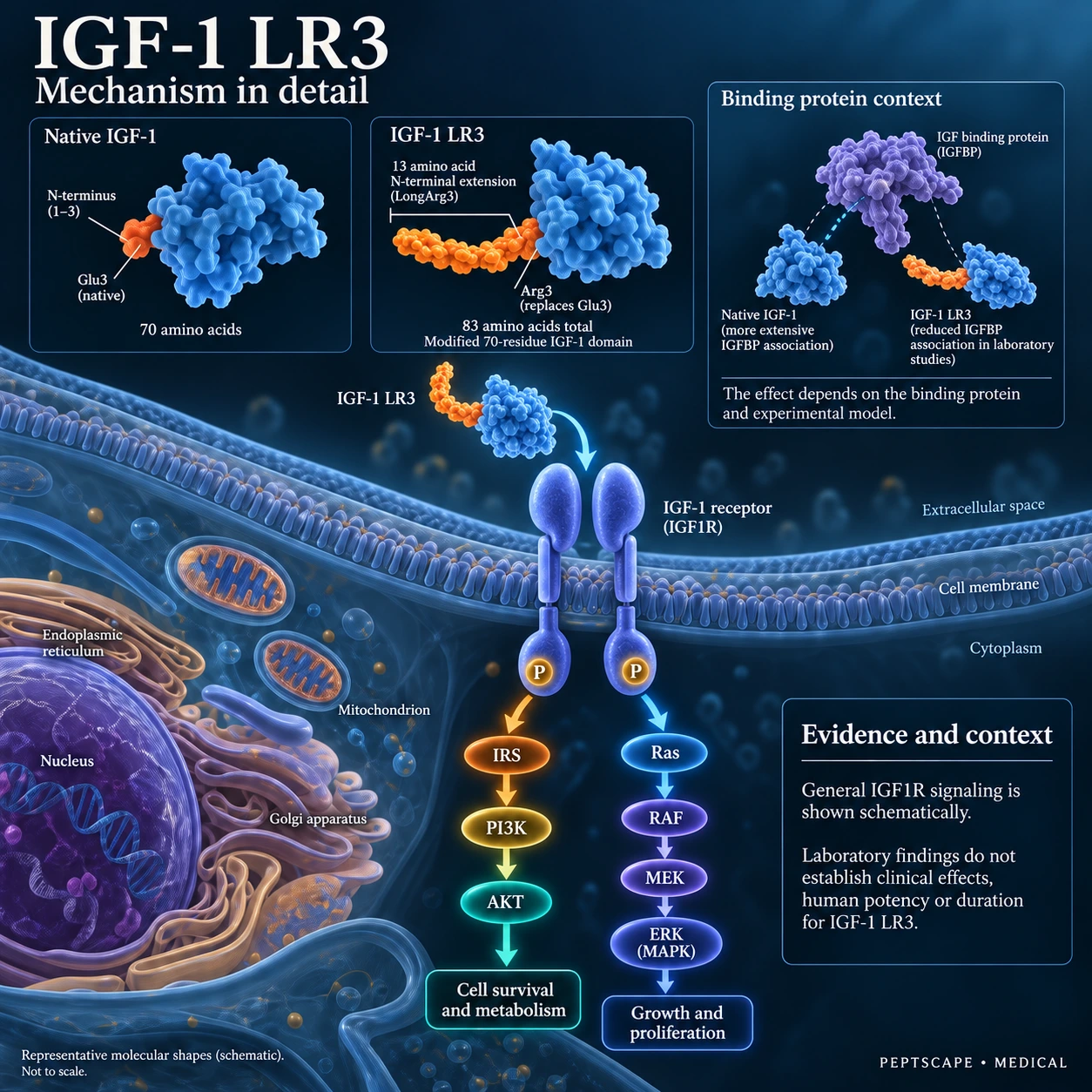
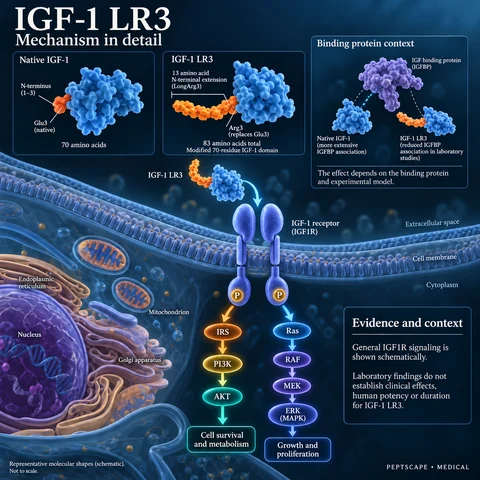
Educational illustration · Read the evidence and limitations below.
Evidence in perspective
The long-R3 analogue differs from native IGF-I and licensed mecasermin. Reduced binding-protein affinity does not by itself establish a human half-life, superior results or safety.
About this assessment
Existing source snapshot critically reassessed.
Based on the selected source scope described in this profile, often an indexed abstract. Full methods and clinician sign-off remain pending; no systematic-review claim.
Laboratory systems and rats; human tissue assays are not human dosing trials.
What the sources found
Experimental activity varies with binding proteins and the model. This does not establish clinical physique, recovery or site-specific growth benefits.
Regulatory scope
US: the cited INCRELEX label concerns mecasermin, not this modified IGF-1. Its authorization cannot be assigned to this derivative. A complete derivative-specific jurisdictional review remains outstanding.
What remains unknown
Selected abstracts and a related medicine label reviewed. No derivative-matched human dosing, efficacy, PK, long-term safety or stability was verified; this is not an exhaustive clinical review.
How it works
Modified IGF-1 with reduced binding-protein affinity; longer human exposure is not established by that property.
A 1992 study found that LR3 activity depended on the cell system and its IGF-binding proteins. In cells without detectable secreted binding proteins, LR3 was less potent than IGF-1. Reduced binding is not equivalent to universal superiority.
The related mecasermin medicine label warns about severe hypoglycemia and neoplasia. This supports caution about IGF-pathway effects, but does not supply adverse-event rates for this derivative.
Related mecasermin risks support precaution only; not derivative-specific rates.
A complete product-specific contraindication and interaction assessment remains unavailable in this review. Missing evidence does not establish safety, including during pregnancy or breastfeeding.
IGF-related glucose and growth effects require particular clinical attention with diabetes or a malignancy history. This is precautionary context, not a validated derivative-specific contraindication list.
Preclinical research
The catalog primarily cites laboratory or animal research. Human benefit, a safe dose and long-term risks cannot be inferred from those findings.
IGF-1 LR3 is a modified IGF-1 research protein with a 13-residue N-terminal extension and an arginine replacing glutamate at position 3 of the IGF-1 sequence. It is structurally distinct from intact IGF-1 and DES.
NMR construct identity, not product authentication.
A 1992 study found that LR3 activity depended on the cell system and its IGF-binding proteins. In cells without detectable secreted binding proteins, LR3 was less potent than IGF-1. Reduced binding is not equivalent to universal superiority.
No matched human LR3 elimination half-life was verified. In a rat renal-failure model, LR3 clearance increased. Reduced binding-protein affinity alone does not establish the inherited 20–30 hour human claim.
Rat disease model; human half-life remains unknown.
The related mecasermin medicine label warns about severe hypoglycemia and neoplasia. This supports caution about IGF-pathway effects, but does not supply adverse-event rates for this derivative.
Related mecasermin risks support precaution only; not derivative-specific rates.
Laajoki LG, Le Breton E, Shooter GK, Wallace JC, Francis GL, Carver JA, Keniry MA. Secondary structure determination of 15N-labelled human Long-[Arg-3]-insulin-like growth factor 1 by multidimensional NMR spectroscopy. 1997.
Francis GL, Ross M, Ballard FJ, Milner SJ, Senn C, McNeil KA, Wallace JC, King R, Wells JR. Novel recombinant fusion protein analogues of insulin-like growth factor (IGF)-I indicate the relative importance of IGF-binding protein and receptor binding for enhanced biological potency. 1992.
Gillespie CM, Hazel SJ, Walton PE, Martin AA. Effects of chronic renal failure on plasma clearance of insulin-like growth factor I, des-(1-3)IGF-I, and LR3IGF-I. 1996.
DailyMed. INCRELEX (mecasermin), US prescribing information, revised October 2025. Related medicine only; not an LR3 or DES label. Checked September 7, 2026.