Identity
Hyaluronic acid occurs in different products; approval applies to an identified device and use, not the ingredient universally.
Source-specific finding, not full clinical sign-off.
Peptide library
Your guide to this compound.
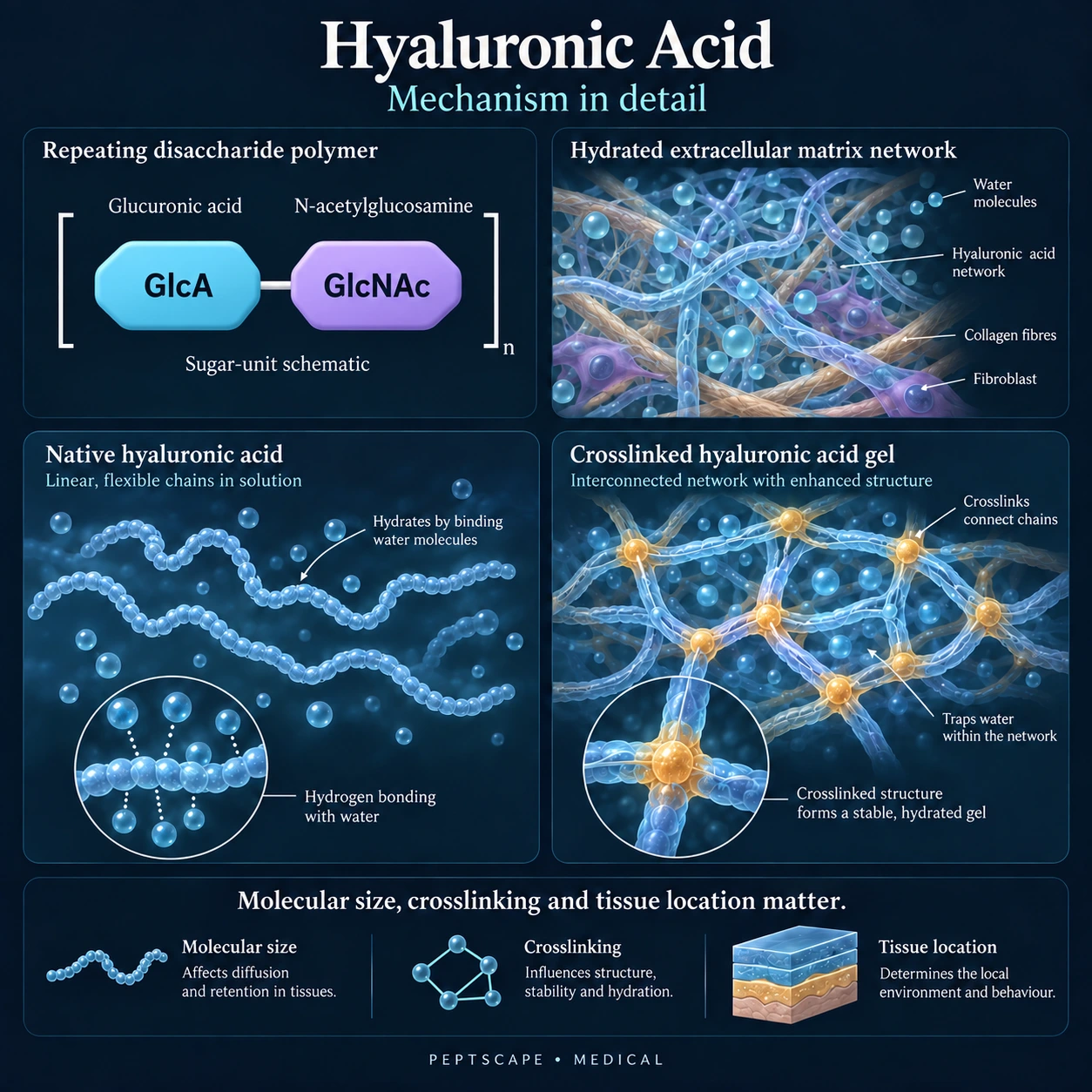
Regulatory guidance applies to particular fillers, injection sites and professional procedures. Hyaluronic acid also appears in unrelated products; a shared ingredient name is not a universal approval or safe home-injection instruction.
Existing source snapshot critically reassessed.
Based on the selected source scope described in this profile, often an indexed abstract. Full methods and clinician sign-off remain pending; no systematic-review claim.
Editorial assessment · 2026-09-07
FDA consumer guidance on dermal fillers.
Approved filler uses are product- and site-specific. This does not validate home injection or a generic hyaluronic-acid regimen.
FDA approvals apply to particular dermal filler devices and indications. No blanket approval of arbitrary hyaluronic-acid formulations is implied.
Limited selected-source check, not an exhaustive review. Full methods, complete safety, exact formulation/route pharmacokinetics, stability and current jurisdictional authorization remain outstanding.
Hyaluronic acid occurs in different products; approval applies to an identified device and use, not the ingredient universally.
Read the source-specific findings; biological activity is not equivalent to a clinical treatment benefit.
Approval applies to a particular product and indication. It does not extend to every use, route, compounded preparation or research vial sold under the same compound name. Check the current prescribing information.
Source-specific finding, not full clinical sign-off.
Approval applies to a particular product and indication. It does not extend to every use, route, compounded preparation or research vial sold under the same compound name. Check the current prescribing information.
Hyaluronic acid occurs in different products; approval applies to an identified device and use, not the ingredient universally.
Source-specific finding, not full clinical sign-off.
Approved filler uses are product- and site-specific. This does not validate home injection or a generic hyaluronic-acid regimen.
Source-specific finding, not full clinical sign-off.
Accidental vascular injection can cause necrosis, blindness or stroke.
Source-specific finding, not full clinical sign-off.
FDA. Dermal Filler Do’s and Don’ts. Selected scope and safety guidance. Checked September 7, 2026.
Catalog review date: Sep 7, 2026. This date alone does not establish independent clinical review.