Identity
Humanin is a short peptide identified through experiments on neuronal survival.
Cultured neuronal models exposed to Alzheimer-related insults.
Peptide library
Your guide to this compound.
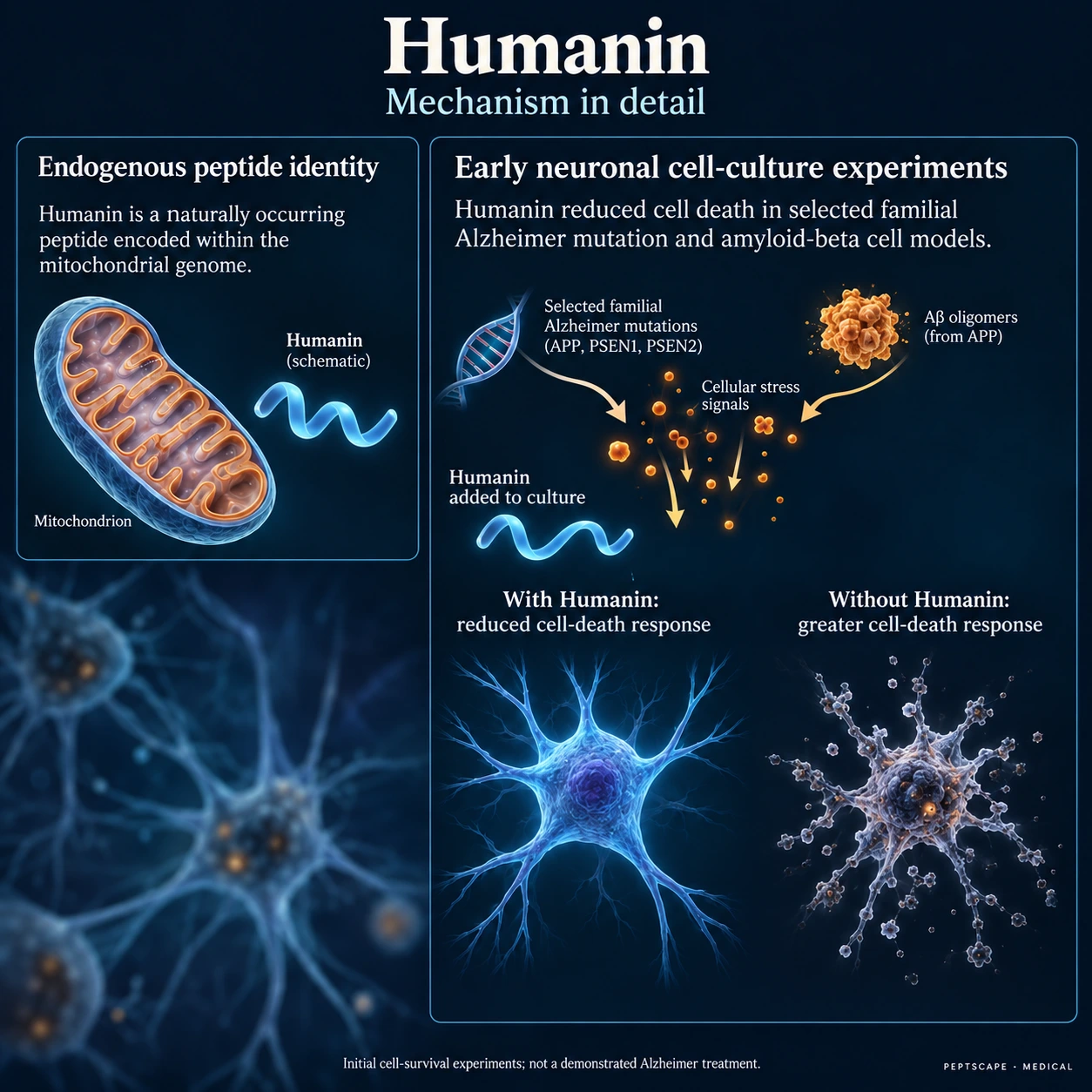
The founding experiments concern neuronal survival in laboratory models. Donor-cell origin does not create human treatment evidence. An indexed correction to the early paper still needs its exact content reconciled before a full source appraisal can close.
Existing source snapshot critically reassessed.
Based on the selected source scope described in this profile, often an indexed abstract. Full methods and clinician sign-off remain pending; no systematic-review claim.
Editorial assessment · 2026-09-07
Cultured neuronal models exposed to Alzheimer-related insults.
The original study reported reduced cell death in selected experimental models; it was not a dementia treatment trial.
Cultured neuronal models exposed to Alzheimer-related insults.
No jurisdiction-specific marketing authorization has been verified in this snapshot; study publication is not regulatory approval.
These findings do not establish human efficacy, long-term safety, or equivalence to products sold under this name. This is a focused source snapshot, not an exhaustive clinical review.
Humanin is a short peptide identified through experiments on neuronal survival.
Read the study-specific findings and limitations in Medical. Mechanistic activity does not establish a treatment benefit.
The catalog primarily cites laboratory or animal research. Human benefit, a safe dose and long-term risks cannot be inferred from those findings.
The catalog primarily cites laboratory or animal research. Human benefit, a safe dose and long-term risks cannot be inferred from those findings.
Humanin is a short peptide identified through experiments on neuronal survival.
Cultured neuronal models exposed to Alzheimer-related insults.
The original study reported reduced cell death in selected experimental models; it was not a dementia treatment trial.
Cultured neuronal models exposed to Alzheimer-related insults.
Hashimoto et al. A rescue factor abolishing neuronal cell death. PNAS. 2001.
PMID: 11371646
Humanin in human cerebrovascular smooth muscle cell cultures. 2003.
PMID: 12558989
Catalog review date: Sep 6, 2026. This date alone does not establish independent clinical review.