Educational illustration · Read the evidence and limitations below.
What is Gonadorelin?
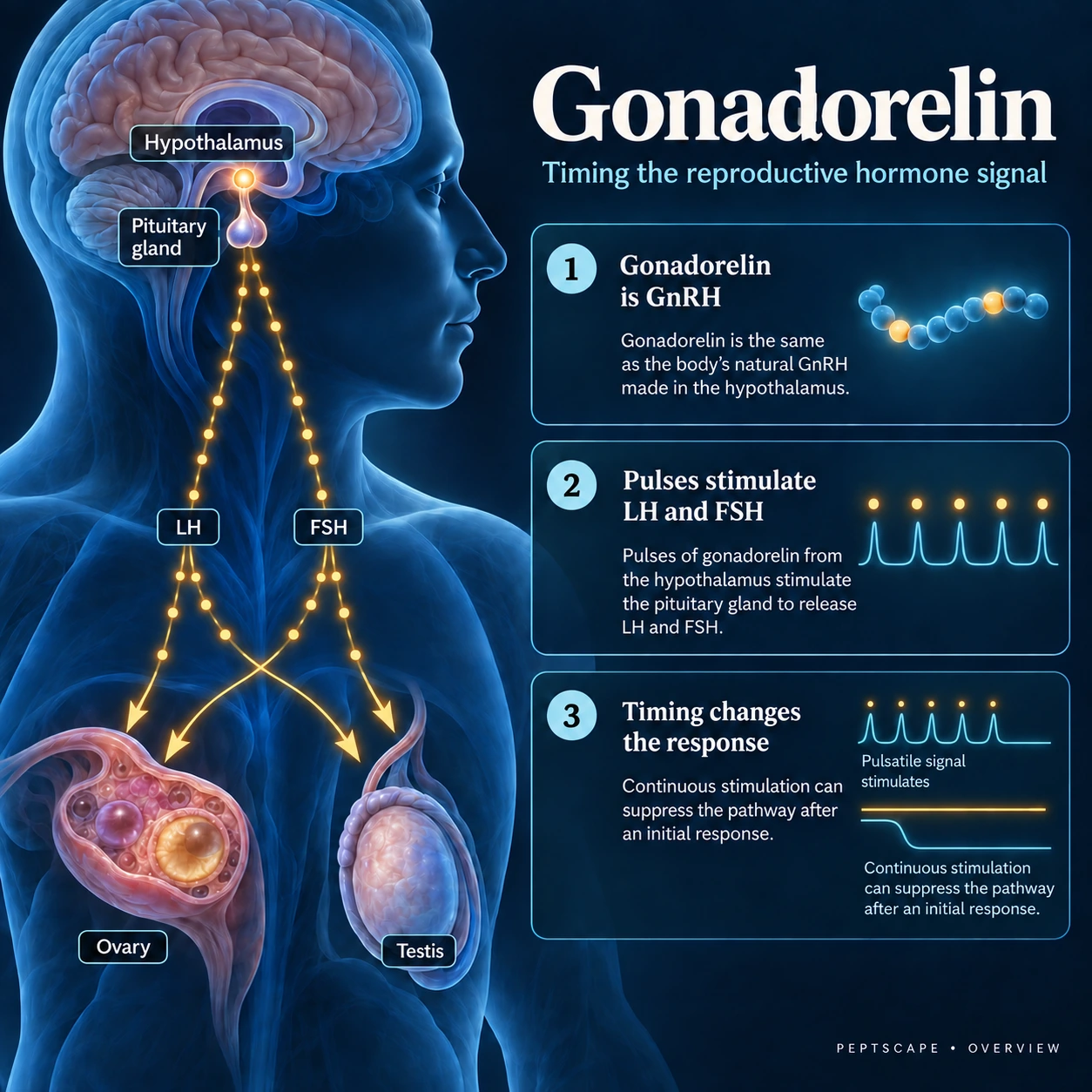
Gonadorelin is a manufactured form of gonadotropin-releasing hormone, usually shortened to GnRH. It acts upstream in the reproductive hormone system by signalling the pituitary to release LH and FSH. It does not directly replace testosterone, oestrogen, LH or FSH.
The wider picture
Reproductive hormones form a communication chain. The brain signals the pituitary; the pituitary releases LH and FSH; the ovaries or testes respond. Feedback then travels back through the system. LH and FSH have different roles, and replacing or stimulating one signal is not the same as correcting every possible cause of infertility or low sex-hormone levels.
The reproductive hormone chain contains several checkpoints. An upstream signal may be present while the pituitary or gonads cannot respond adequately. Conversely, those organs may function but receive insufficient stimulation. Knowing where the problem lies explains why two people with a similar hormone result may need different care.
What it is used for
Its uses include specialised assessment and treatment of reproductive hormone disorders. In some settings, a pump delivers carefully timed pulses. This is different from occasional injections intended for general hormone optimisation. A reproductive system that cannot respond at another point in the chain may not be corrected simply by adding an upstream signal.
Understanding the intended benefit
Fertility, sexual desire and hormone deficiency are separate questions. A change in a hormone measurement does not automatically improve sperm production, ovulation or sexual wellbeing. The timing of testing matters, and fertility assessment may involve both partners. Treatment aimed at inducing follicle growth or ovulation needs monitoring because the number and size of developing follicles affect both benefit and risk.
Fertility outcomes take time. Sperm production develops over a much longer interval than a short-lived hormone spike, while follicle monitoring follows the stages of an individual treatment cycle. Daily impressions of energy or libido cannot replace those assessments. A treatment record should distinguish the purpose of each hormone and the planned monitoring point.
How it works
The rhythm of GnRH exposure is central to its action. Natural pulses carry a different message from continuous stimulation. The pituitary's response can change with sustained exposure, which is why frequency cannot be inferred from vial strength alone. Gonadorelin and longer-acting GnRH analogues also have different properties and purposes.
The biology in plain language
The pattern of stimulation can be as important as the amount. Pulses, a sustained infusion and occasional injections may send different messages to the same receptor system. Some treatments act upstream at the pituitary, while others act directly at the gonads. A vial labelled in international units is describing biological activity; it is not describing the unit marks on an insulin syringe. Product identity and concentration must remain separate from the intended hormonal goal.
More stimulation is not automatically a better response. Excessive ovarian stimulation can cause serious illness, and attempts to optimise one sex-hormone value can alter feedback elsewhere in the chain. Existing testosterone or other hormone treatment may also change fertility. These interactions make the full treatment history more informative than a single peptide name or a single blood result.