Identity
Copper-free GHK is Gly-His-Lys; it is distinct from the copper complex GHK-Cu.
Source-specific finding, not full clinical sign-off.
Peptide library
Your guide to this compound.
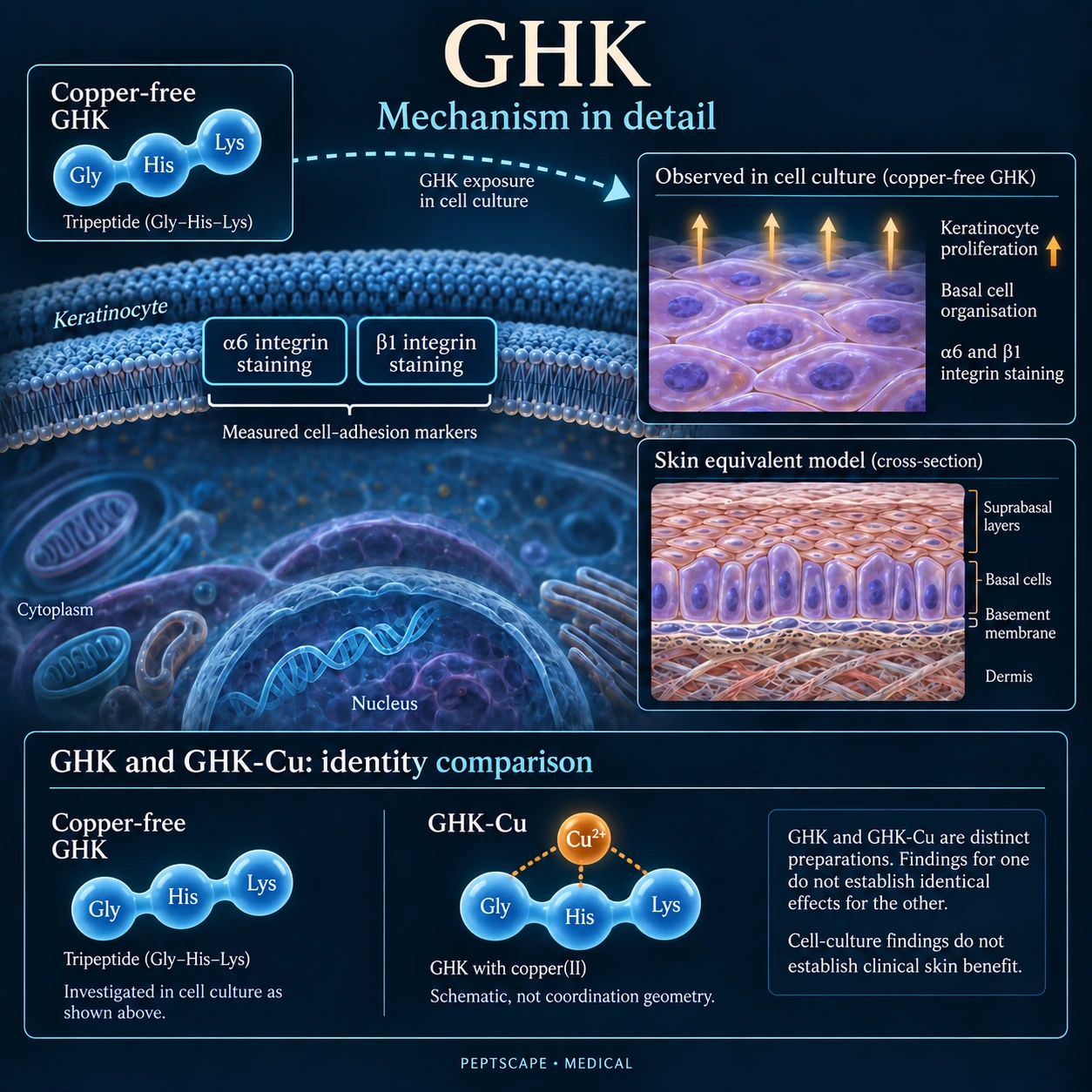
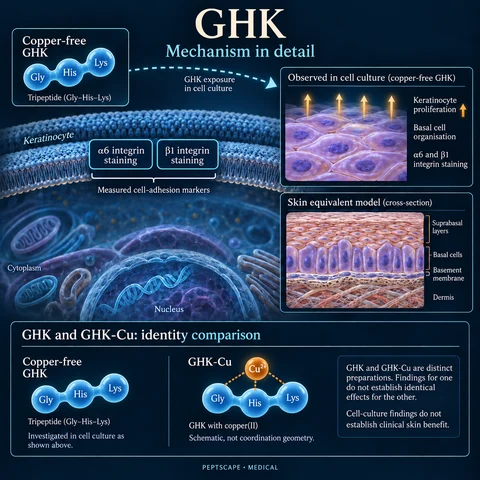
Human keratinocytes in culture are not treated human participants. Copper-free GHK must remain separate from GHK-Cu, and skin-model markers do not establish clinical wound repair.
Existing source snapshot critically reassessed.
Based on the selected source scope described in this profile, often an indexed abstract. Full methods and clinician sign-off remain pending; no systematic-review claim.
Editorial assessment · 2026-09-07
Cultured human keratinocytes and reconstructed skin models.
Cell proliferation and selected skin-model markers changed. These were not clinical wrinkle or wound-healing outcomes.
Current authorization must be checked for the exact product, indication and jurisdiction.
Limited selected-source check, not an exhaustive review. Full methods, complete safety, exact formulation/route pharmacokinetics, stability and current jurisdictional authorization remain outstanding.
Copper-free GHK is Gly-His-Lys; it is distinct from the copper complex GHK-Cu.
Read the source-specific findings; biological activity is not equivalent to a clinical treatment benefit.
The catalog primarily cites laboratory or animal research. Human benefit, a safe dose and long-term risks cannot be inferred from those findings.
Source-specific finding, not full clinical sign-off.
The catalog primarily cites laboratory or animal research. Human benefit, a safe dose and long-term risks cannot be inferred from those findings.
Copper-free GHK is Gly-His-Lys; it is distinct from the copper complex GHK-Cu.
Source-specific finding, not full clinical sign-off.
Cell proliferation and selected skin-model markers changed. These were not clinical wrinkle or wound-healing outcomes.
Source-specific finding, not full clinical sign-off.
Cell-culture findings do not establish injectable safety or clinical benefit.
Source-specific finding, not full clinical sign-off.
Stem cell recovering effect of copper-free GHK in skin. 2012.
PMID: 23019153
Catalog review date: Sep 7, 2026. This date alone does not establish independent clinical review.