Educational illustration · Read the evidence and limitations below.
What is FLGR-242?
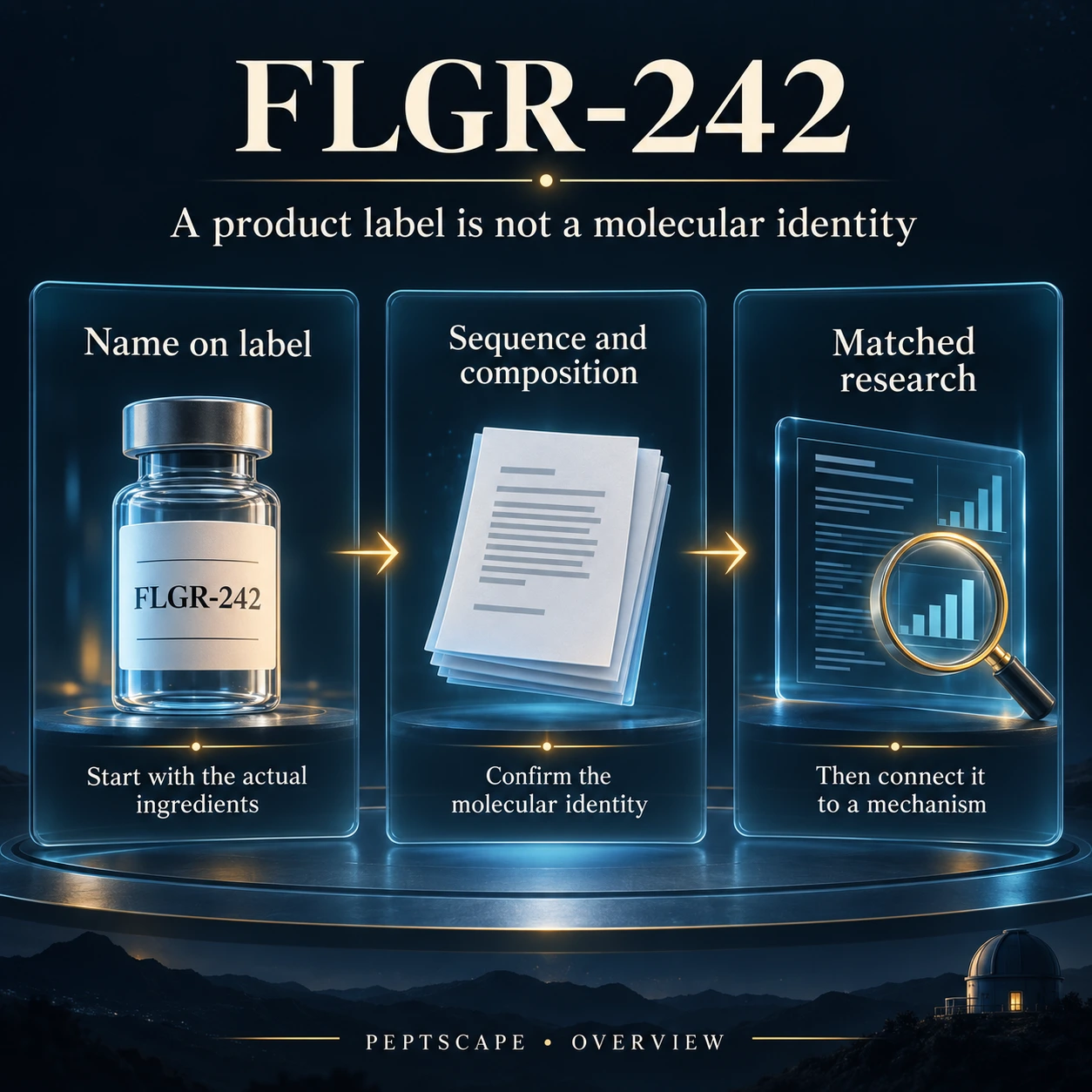
FLGR-242 is a product designation used in the peptide marketplace, rather than a sufficiently documented molecular identity in this catalog. It has been associated with muscle-growth and myostatin-related descriptions. That tells the reader the claimed purpose, but not exactly which molecule or mixture is present.
The wider picture
A blend combines ingredients in one preparation. Its name is a shortcut, not a complete specification. To understand it, identify each ingredient, the amount of each ingredient and the total contents of the container. A total such as 50 mg does not tell you how that amount is divided between the components. Different products can use the same blend name while containing different ratios.
The total mass and the amount of each component are different pieces of information. If a product contains several active ingredients, the concentration of each depends on its own amount and the final volume. Knowing only the combined total leaves an essential part of the record missing. A calculator should preserve those distinctions rather than inventing a standard ratio.
What it is used for
The proposed use is body composition and muscle development. The key missing detail is the identity needed to connect the product to reliable information about its action. FLGR-242 must not be silently relabelled as follistatin, ACE-031 or MID-35: those names refer to different proteins or peptides. A useful profile explains that distinction instead of assigning another compound's benefits to this label.
Understanding the intended benefit
The intended uses of the ingredients do not automatically establish the effect of their combination. Ingredients can overlap, act at different targets or require different routes and handling. A blend also fixes their ratio: increasing the amount of the mixture increases all components together. That can make it harder to identify which ingredient caused a benefit or an unwanted reaction.
Separate ingredients may have different timescales for desired and unwanted effects. One may cause an immediate reaction while another has a slower biological response. Because a fixed blend changes all ingredients together, adjusting it does not isolate the component responsible. This is one reason an apparently convenient combination can be harder to assess than individually documented preparations.
How it works
To interpret a report, look for the complete compound name or sequence, ingredient amounts and a lot-linked identity test. A purity percentage without a matching identity does not resolve what the product is. Until that connection is established, preparation amounts, half-life and pathway claims from related compounds cannot be transferred to FLGR-242.
The biology in plain language
A mixture needs its own compatibility and stability information. Two ingredients being soluble separately does not prove that they remain suitable when stored together. A certificate of analysis can help describe what was tested, but purity, amount, sterility and identity are separate results. Keep the original label and report with the vial, and compare the compound names and lot number rather than relying on the blend name alone.
The original report is useful only in relation to what it tested. Chromatographic purity is not the same as the amount of each ingredient, and neither establishes sterility. A lot match improves traceability but does not prove that every container has the same contents. These are practical distinctions for reading a blend's documentation, not reasons to discard the original product details.