Educational illustration · Read the evidence and limitations below.
Evidence in perspective
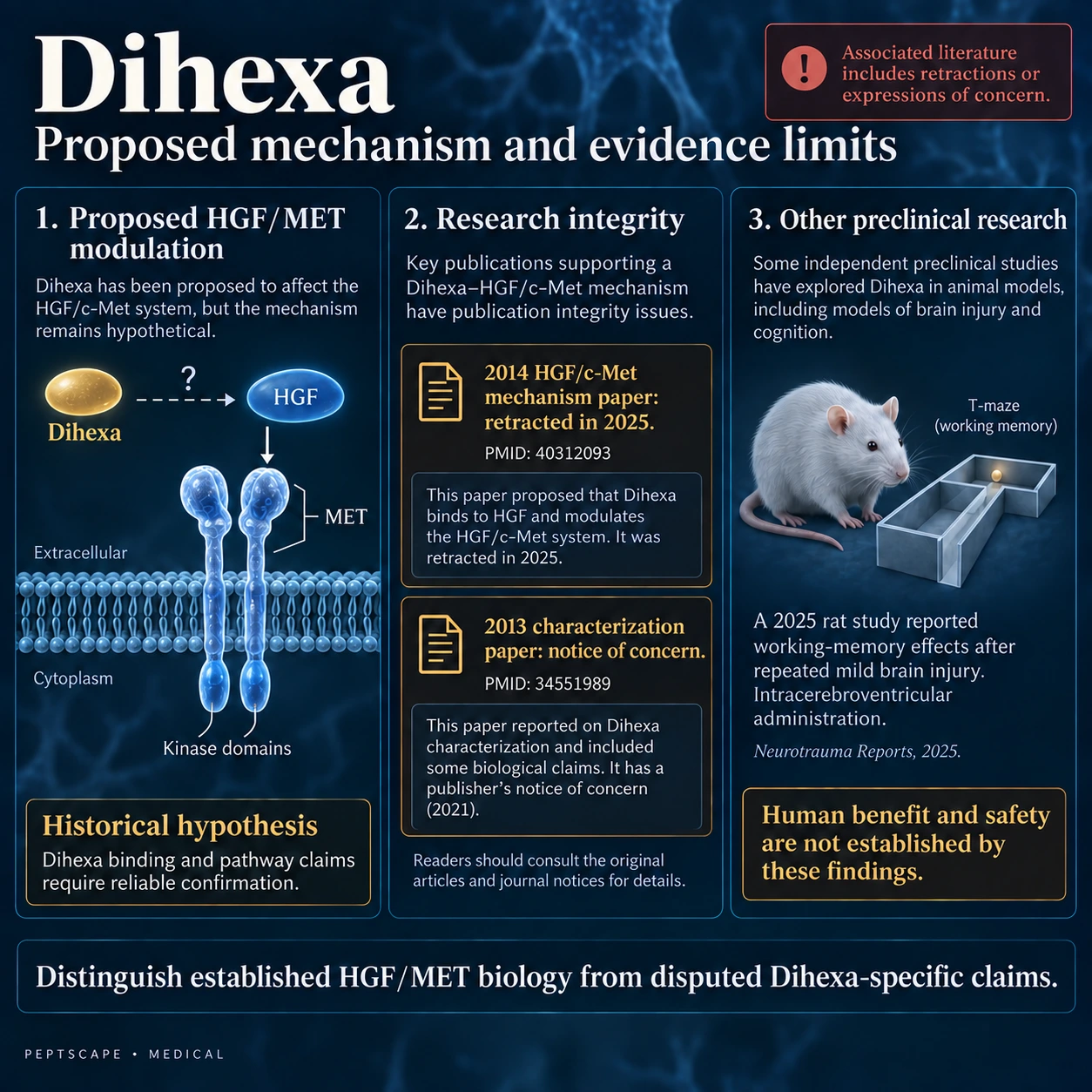
An expression of concern and a retraction are distinct editorial actions; both reduce confidence in the affected development claims. The retracted paper is not valid affirmative support. Unaffected independent evidence and human outcomes remain necessary.
About this assessment
Existing source snapshot critically reassessed.
Based on the selected source scope described in this profile, often an indexed abstract. Full methods and clinician sign-off remain pending; no systematic-review claim.
Rodent models and neuronal cultures in the early development literature; publication-status notices were checked separately.
What the sources found
The 2013 development paper reported rodent learning and cell-culture findings, but carries a 2021 notice of concern. It does not establish cognitive benefit in people.
Editorial notice, read alongside the 2013 development report.
U.S.: FDA lists this substance among withdrawn compounding nominations with safety concerns; this does not establish approval.
What remains unknown
The 2013 notice of concern and the 2014 paper’s retraction are different editorial actions. Later independent studies and human trial registries still require systematic review. Targeted source snapshot, not a full clinical review. Product stability, interactions and jurisdiction-specific authorization remain outstanding.
How it works
HGF/c-Met signaling is a proposed mechanism. The 2014 paper used to support this mechanism was retracted in 2025; this profile does not treat that paper as reliable proof of the pathway.
HGF/c-Met signaling is a proposed mechanism. The 2014 paper used to support this mechanism was retracted in 2025; this profile does not treat that paper as reliable proof of the pathway.
Publication status only; the retraction is not new biological evidence.
HGF/c-Met signaling is a proposed mechanism. The 2014 paper used to support this mechanism was retracted in 2025; this profile does not treat that paper as reliable proof of the pathway.
Publication status only; the retraction is not new biological evidence.
The 2013 development paper reported rodent learning and cell-culture findings, but carries a 2021 notice of concern. It does not establish cognitive benefit in people.
Historical animal/culture report carrying a notice of concern; not accepted clinical evidence.
The 2013 development paper reported rodent learning and cell-culture findings, but carries a 2021 notice of concern. It does not establish cognitive benefit in people.
Editorial notice, read alongside the 2013 development report.
Retraction notice to "The Procognitive and Synaptogenic Effects of Angiotensin IV-Derived Peptides Are Dependent on Activation of the Hepatocyte Growth Factor/c-Met System" [J Pharmacol Exp Ther 351 (2014) 390-402]. 2025.