Educational illustration · Read the evidence and limitations below.
Evidence in perspective
The masked randomized proof-of-concept study did not meet the primary weight-loss comparison. Hierarchical testing and sensitivity analyses should be respected; a plausible dual-receptor mechanism cannot substitute for a positive clinical result.
About this assessment
Selected full-text methods/results or correction sections assessed.
This assessment covers selected sources and sections. It is not a systematic review, formal risk-of-bias score, or clinician sign-off.
Adults with obesity in a randomized proof-of-concept trial.
What the sources found
In the 54-person, 12-week trial, the 6 mg group’s estimated difference versus placebo was −2.1 percentage points (95% CI −4.3 to 0.2; p=0.076). The primary weight-loss comparison was not statistically significant. Further benefit at other doses or durations remains a research question.
Single-centre phase IIa trial in adults with obesity without diabetes; efficacy estimand, not head-to-head superiority.
The trial used sex-stratified randomization, masked study materials and hierarchical testing, but only 54 participants and 12 weeks of follow-up. Missing outcomes were imputed; sensitivity analyses do not create a positive primary result. The funder supplied product and input into planning. Findings do not establish chronic benefit or uncommon harms.
How it works
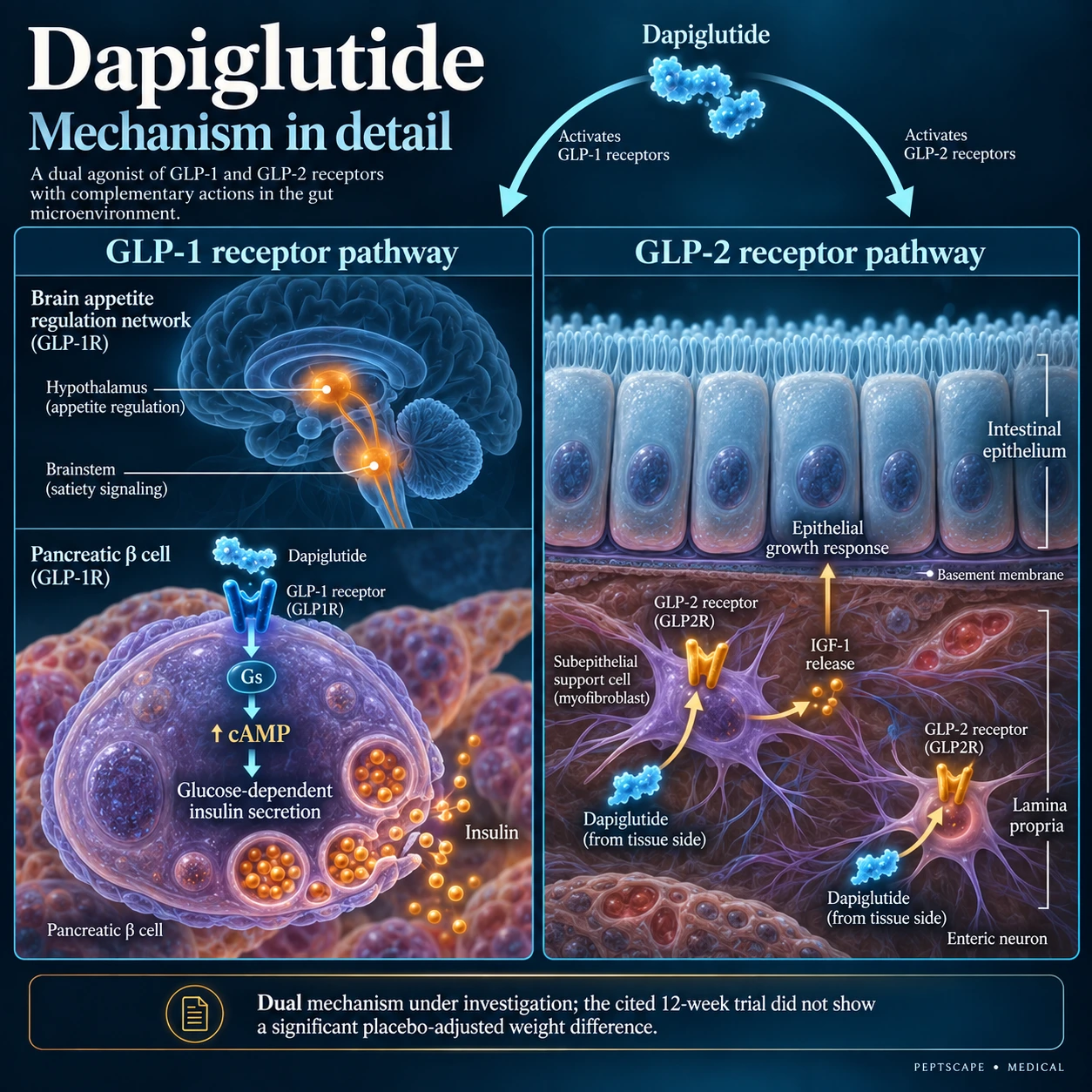
Combines GLP-1 and GLP-2 receptor activity.
Combines GLP-1 and GLP-2 receptor activity. A mechanism-based rationale is not proof of a clinical gut-barrier or anti-inflammatory benefit.
Human trials
This catalog identifies human research. A trial can be early, small or negative; its existence does not establish approval or benefit for every proposed use. Check the study population and outcomes.
Safety details remain incomplete in this snapshot; absence of a listed effect does not mean it was excluded.
Contraindications
This snapshot is not a complete contraindication or interaction review.
Human trials
This catalog identifies human research. A trial can be early, small or negative; its existence does not establish approval or benefit for every proposed use. Check the study population and outcomes.
In the 54-person, 12-week trial, the 6 mg group’s estimated difference versus placebo was −2.1 percentage points (95% CI −4.3 to 0.2; p=0.076). The primary weight-loss comparison was not statistically significant. Further benefit at other doses or durations remains a research question.
Single-centre phase IIa trial in adults with obesity without diabetes; efficacy estimand, not head-to-head superiority.
In the 54-person, 12-week trial, the 6 mg group’s estimated difference versus placebo was −2.1 percentage points (95% CI −4.3 to 0.2; p=0.076). The primary weight-loss comparison was not statistically significant. Further benefit at other doses or durations remains a research question.
Single-centre phase IIa trial in adults with obesity without diabetes; efficacy estimand, not head-to-head superiority.