Identity
Cartalax denotes the tripeptide Ala-Glu-Asp (AED). PubChem records this structure as CID 87815447; it is distinct from the four-residue AEDG peptide.
Catalog identity only; not authentication of a purchased vial or clinical approval.
Peptide library
Your guide to this compound.
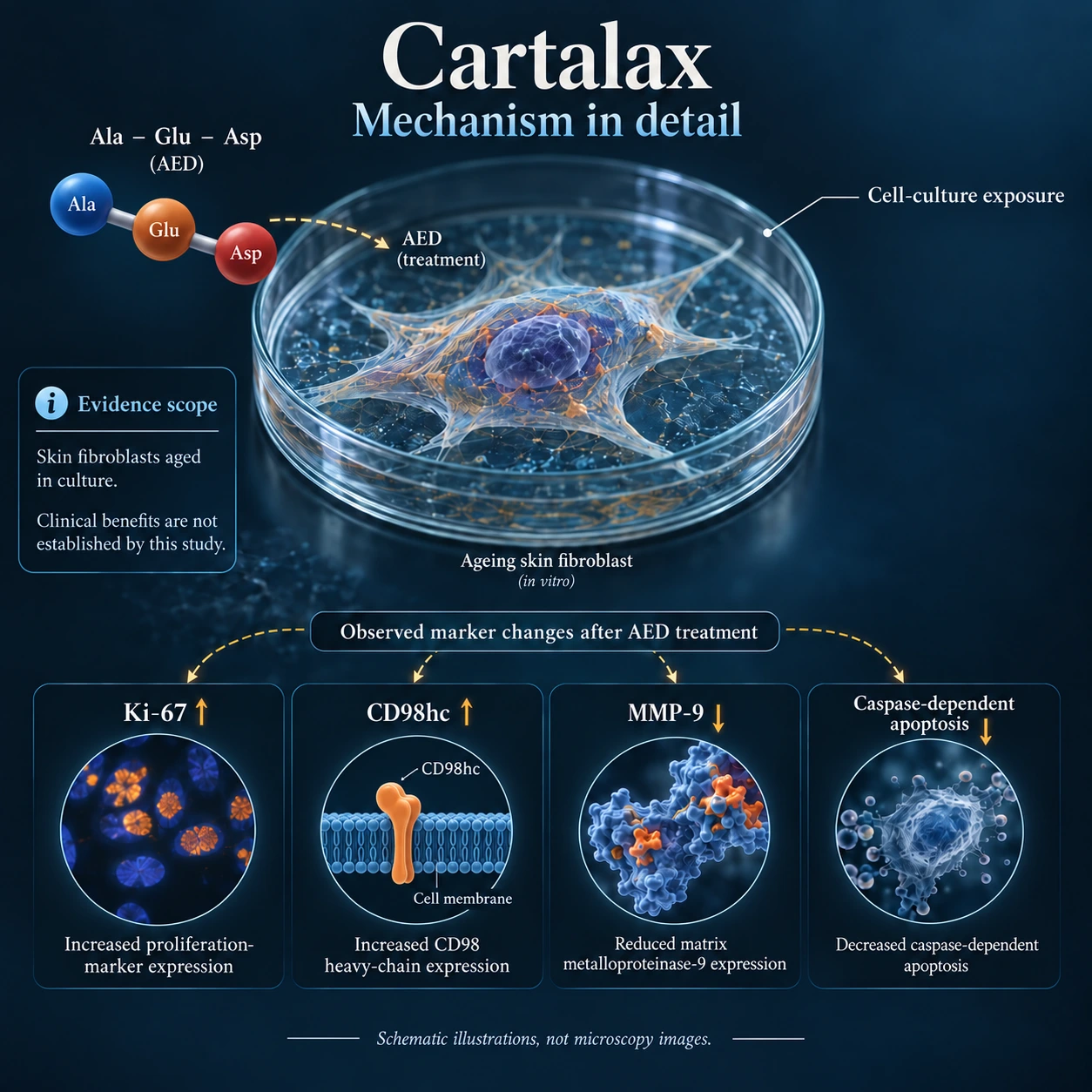
The sequence is documented. The therapeutic question remains open: cultured fibroblast changes are not patient outcomes or evidence that an injected product repairs joints.
Identity sources and selected source evidence assessed; scope below.
Indexed abstract and chemical record assessed. Cell markers do not establish cartilage repair, clinical anti-aging effects or a human regimen. Full clinical review and clinician sign-off remain pending.
Editorial assessment · 2026-09-07
Aging skin-fibroblast cultures; preclinical experiments.
AED was among short peptides associated with changes in proliferation, matrix-remodeling and apoptosis markers in cultured fibroblasts.
Aging skin-fibroblast cultures; preclinical experiments.
Source · Abstract / selected methods and results / product description
Identity documentation and publication do not confer marketing authorization. No new jurisdiction-specific approval claim is made.
Indexed abstract and chemical record assessed. Cell markers do not establish cartilage repair, clinical anti-aging effects or a human regimen. Full clinical review and clinician sign-off remain pending.
Identity and evidence must be read separately.
The sequence is documented. The therapeutic question remains open: cultured fibroblast changes are not patient outcomes or evidence that an injected product repairs joints.
The catalog primarily cites laboratory or animal research. Human benefit, a safe dose and long-term risks cannot be inferred from those findings.
The catalog primarily cites laboratory or animal research. Human benefit, a safe dose and long-term risks cannot be inferred from those findings.
Cartalax denotes the tripeptide Ala-Glu-Asp (AED). PubChem records this structure as CID 87815447; it is distinct from the four-residue AEDG peptide.
Catalog identity only; not authentication of a purchased vial or clinical approval.
AED was among short peptides associated with changes in proliferation, matrix-remodeling and apoptosis markers in cultured fibroblasts.
Aging skin-fibroblast cultures; preclinical experiments.
Abstract / selected methods and results / product description
PubChem. Alanyl-glutamyl-aspartic acid, CID 87815447. Identity record.
Linkova et al. Peptide Regulation of Skin Fibroblast Functions during Their Aging In Vitro. 2016.
PMID: 27259496
Catalog review date: Sep 7, 2026. This date alone does not establish independent clinical review.