Educational illustration · Read the evidence and limitations below.
What is Bacteriostatic Water?
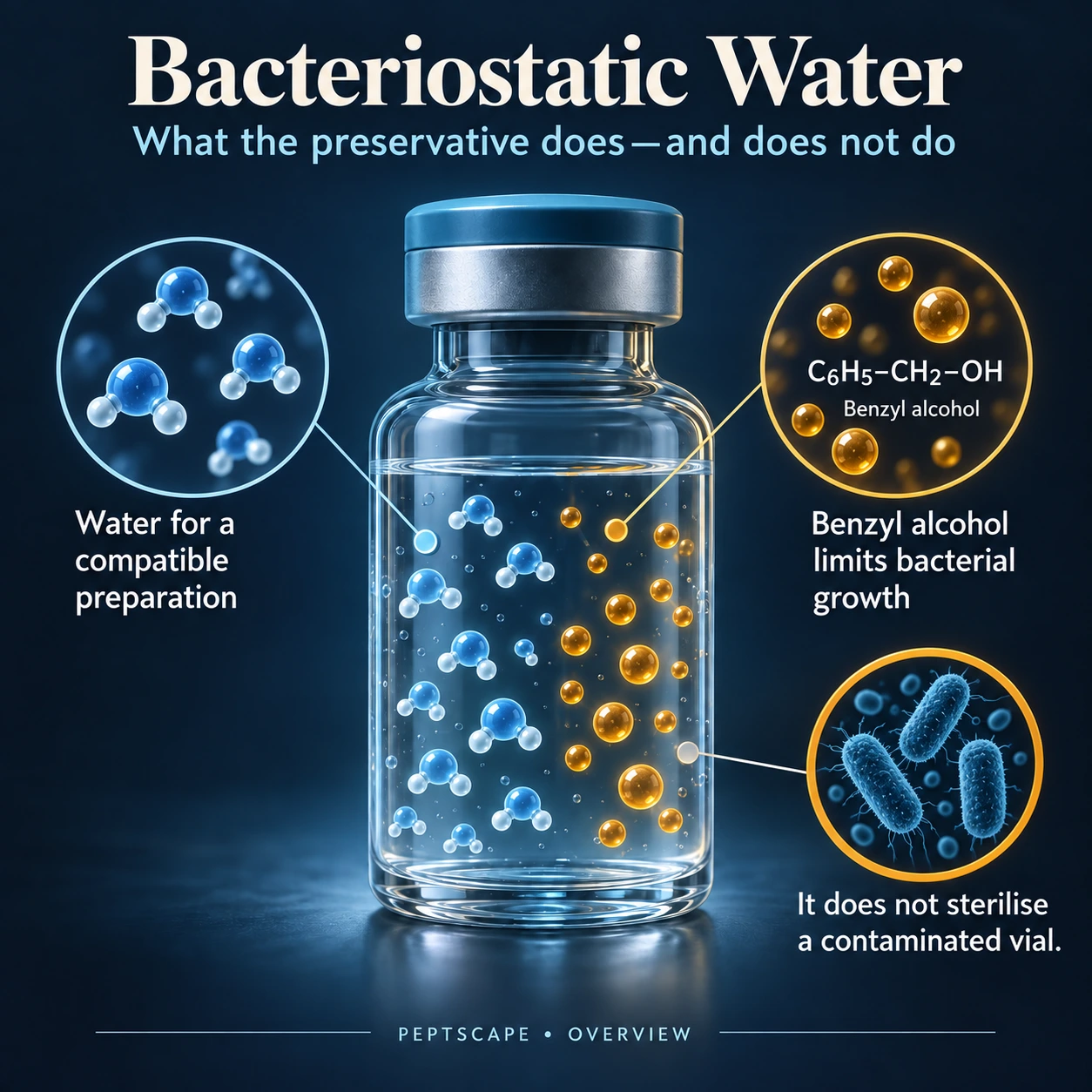
Bacteriostatic water is sterile water containing a preservative, usually benzyl alcohol, in a preparation intended for specified pharmaceutical dilution or reconstitution. It is not a treatment by itself. The preservative distinguishes it from preservative-free sterile water for injection.
The wider picture
A preparation liquid has a specific job: it dissolves or dilutes a medicine into the formulation intended for use. It is not an active peptide, and changing the liquid can change acidity, preservative exposure and stability. Clear appearance alone does not show that a solution is compatible with a particular compound or suitable for an intended route.
Lyophilised means freeze-dried. Removing water can help a preparation remain stable before use, but it does not guarantee the stability of the solution after reconstitution. The unopened expiry date and the after-mixing discard date answer different questions and should be recorded separately.
What it is used for
Its use depends on the instructions for the medicine being prepared. It is not automatically suitable for every lyophilised peptide, and it does not create a universal refrigerated shelf life after mixing. Benzyl alcohol is an important limitation, particularly in newborns and certain routes or formulations. The container must identify the product and intended use.
Understanding the intended benefit
Reconstitution means adding a specified liquid to lyophilised material. Dilution means lowering the concentration of an existing solution. These are related but different steps. The final concentration depends on the total active amount and final volume; it does not determine which liquid is compatible or how long the prepared material can be kept.
A syringe's markings describe volume according to its design. They do not identify the amount of every medicine placed inside it. Concentration connects volume to active amount, but it cannot determine the correct dose or repair uncertainty about which diluent was used. The name, strength and final volume all belong in the preparation record.
How it works
The preservative reduces the growth of some microorganisms under the product's specified conditions. It does not remove endotoxin, repair poor handling or sterilise an already contaminated vial. A clear solution can still be contaminated. Record the opening date of the diluent separately from the reconstitution date and discard date of the prepared medicine.
The biology in plain language
Keep the container label, opening date and preparation instructions together. Single-use and multidose containers have different handling requirements. A preservative helps control certain contamination risks during appropriate use; it does not sterilise a contaminated vial. Do not substitute household, drinking or laboratory water for an injectable diluent. Product-specific instructions take precedence over a generic mixing chart, including instructions about storage and discarding unused material.
An intact seal, appropriate storage and clean handling reduce avoidable problems but do not replace product quality controls. Unexpected particles, a damaged closure or an uncertain handling history need assessment. Heating, filtering or adding preservative at home is not a dependable way to rescue a questionable preparation.