Identity
Amycretin is a single-molecule investigational GLP-1 and amylin receptor agonist.
Selected study only; not a complete clinical review.
Peptide library
Your guide to this compound.
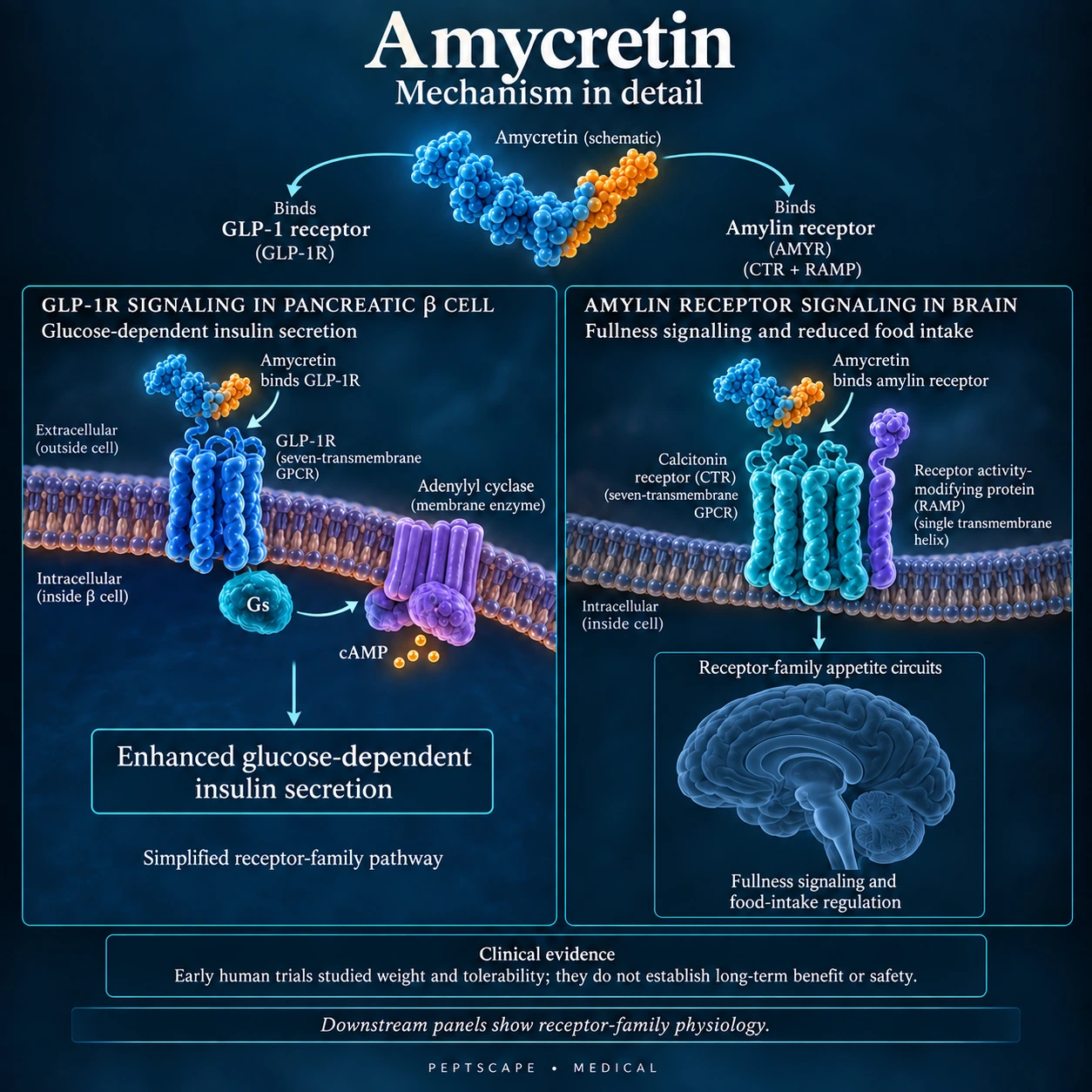
The cited first-in-human oral study primarily characterizes exposure and tolerability. Weight changes are exploratory, and results cannot be reassigned to a subcutaneous formulation or compared directly with phase III products.
Existing source snapshot critically reassessed.
Based on the selected source scope described in this profile, often an indexed abstract. Full methods and clinician sign-off remain pending; no systematic-review claim.
Editorial assessment · 2026-09-07
144 adults with overweight or obesity; first-in-human oral phase 1 trial.
The study characterized oral exposure and tolerability; weight outcomes were exploratory and require later-phase confirmation.
Current authorization for the exact product and jurisdiction was not independently checked in this snapshot. A clinical trial is not marketing authorization.
Selected indexed primary-study abstract reviewed. Full methods, bias, all safety outcomes, product stability, current jurisdictional authorization and a comprehensive literature search remain outstanding. This is not a complete clinical review.
Amycretin is a single-molecule investigational GLP-1 and amylin receptor agonist.
The study-specific findings below distinguish biological activity from demonstrated treatment benefit.
This catalog identifies human research. A trial can be early, small or negative; its existence does not establish approval or benefit for every proposed use. Check the study population and outcomes.
Selected study only; not a complete clinical review.
This catalog identifies human research. A trial can be early, small or negative; its existence does not establish approval or benefit for every proposed use. Check the study population and outcomes.
Amycretin is a single-molecule investigational GLP-1 and amylin receptor agonist.
Selected study only; not a complete clinical review.
The study characterized oral exposure and tolerability; weight outcomes were exploratory and require later-phase confirmation.
Selected study only; not a complete clinical review.
Events were mild or moderate, commonly gastrointestinal, and increased with dose.
Selected study only; not a complete clinical review.
Safety, tolerability, pharmacokinetics, and pharmacodynamics of the first-in-class GLP-1 and amylin receptor agonist, amycretin: a first-in-human, phase 1, double-blind, randomised, placebo-controlled trial. 2025.
PMID: 40550229
Catalog review date: Sep 7, 2026. This date alone does not establish independent clinical review.