Educational reference

Peptide library

AHK-Cu

Your guide to this compound.

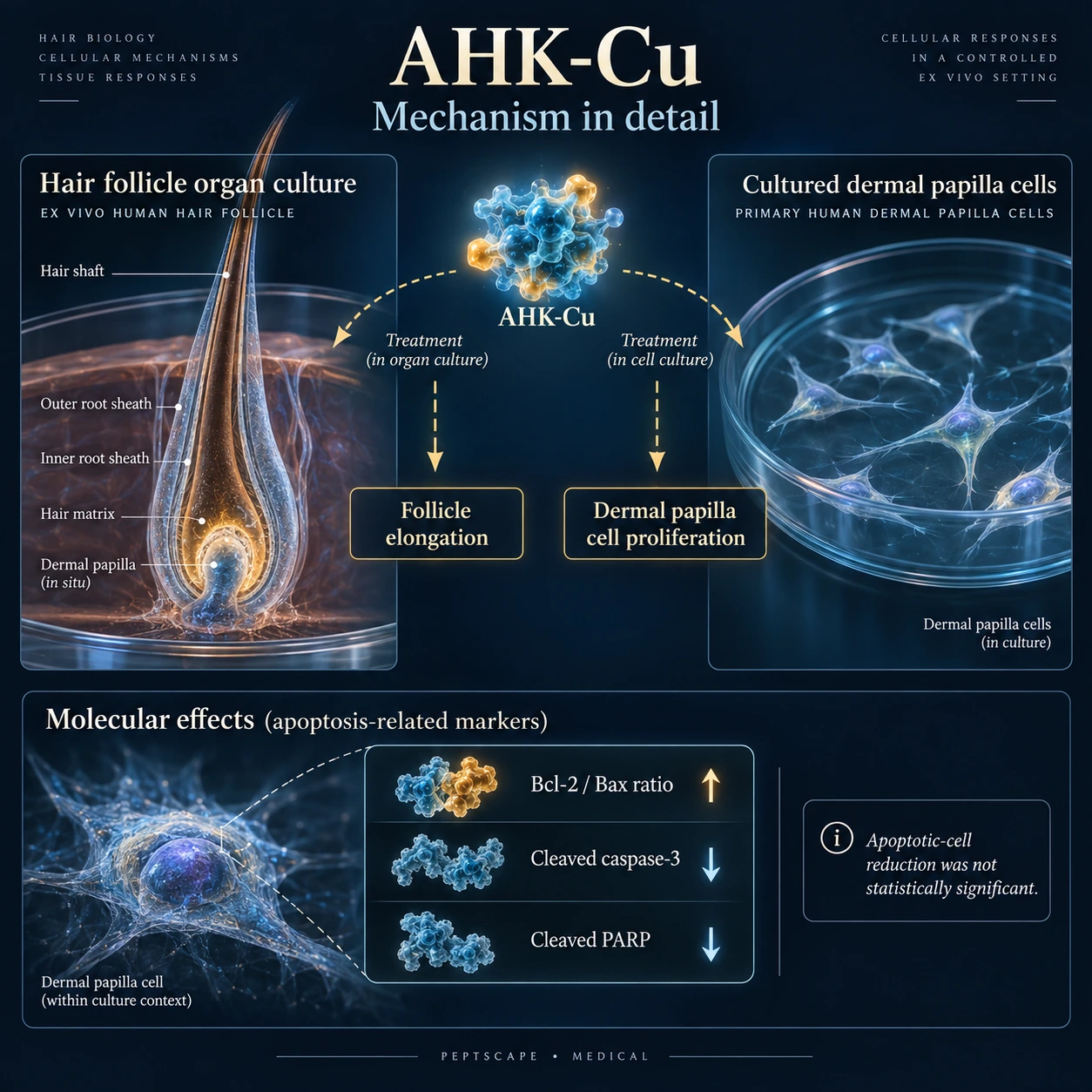
Mechanism illustrationEnlarge
AHK-Cu: Medical scientific diagram. Open full size to read labels; evidence and limitations appear in the profile.
Educational illustration · Read the evidence and limitations below.

Evidence in perspective

Isolated follicles and cultured dermal cells allow mechanistic experiments, but cannot measure a patient’s hair density, cosmetic satisfaction or long-term scalp safety. Copper-peptide identities must stay separate.

About this assessment

Existing source snapshot critically reassessed.

Based on the selected source scope described in this profile, often an indexed abstract. Full methods and clinician sign-off remain pending; no systematic-review claim.

Editorial assessment · 2026-09-07

Source 1 · pubmed.ncbi.nlm.nih.gov

Who was studied

Isolated human follicles ex vivo and cultured cells in vitro; no treated-patient cohort in the cited experiment.

What the sources found

Hair-follicle growth in culture is a research finding; clinical hair density and long-term scalp outcomes were not established.

Ex vivo follicles / in vitro cells; not an injectable or topical clinical product.

Source · Abstract

What remains unknown

A targeted source review, not a complete clinical monograph. Product stability, long-term safety, interactions and jurisdiction-specific authorization require further verification. Research findings do not validate commercial vials.

How it works

Pyo and colleagues observed follicle elongation and dermal papilla cell proliferation under laboratory exposure to AHK-Cu.

Pyo and colleagues observed follicle elongation and dermal papilla cell proliferation under laboratory exposure to AHK-Cu.

Ex vivo follicles / in vitro cells; not an injectable or topical clinical product.

Source · Abstract

Preclinical research

The catalog primarily cites laboratory or animal research. Human benefit, a safe dose and long-term risks cannot be inferred from those findings.

Understanding the evidence

Reported adverse effects

  • The reviewed evidence does not establish adverse-event rates for routine use.

Contraindications

  • The reviewed evidence does not establish a complete clinical contraindication profile.

Preclinical research

The catalog primarily cites laboratory or animal research. Human benefit, a safe dose and long-term risks cannot be inferred from those findings.

Understanding the evidence

Sources used for this snapshot

Source 1 · pubmed.ncbi.nlm.nih.gov

Claim-by-claim evidence

Identity

AHK-Cu is an alanine–histidine–lysine copper complex studied in isolated human hair follicles and cultured dermal papilla cells. That is laboratory research, not evidence that a scalp product reverses hair loss in patients.

Ex vivo follicles / in vitro cells; not an injectable or topical clinical product.
Abstract

Mechanism

Pyo and colleagues observed follicle elongation and dermal papilla cell proliferation under laboratory exposure to AHK-Cu.

Ex vivo follicles / in vitro cells; not an injectable or topical clinical product.
Abstract

Findings

Hair-follicle growth in culture is a research finding; clinical hair density and long-term scalp outcomes were not established.

Ex vivo follicles / in vitro cells; not an injectable or topical clinical product.

Abstract

Dose

The cited experiment tested laboratory concentrations, not a validated scalp-serum concentration or injection regimen.

Ex vivo follicles / in vitro cells; not an injectable or topical clinical product.

Abstract

Pharmacokinetics

No human elimination half-life was established in the cited follicle/cell experiment.

Ex vivo follicles / in vitro cells; not an injectable or topical clinical product.

Abstract

References

  1. Pyo et al. The effect of tripeptide-copper complex on human hair growth in vitro. Arch Pharm Res. 2007;30:834–839.

    Open

Catalog review date: Sep 6, 2026. This date alone does not establish independent clinical review.

Open image for full-resolution zoom