Identity
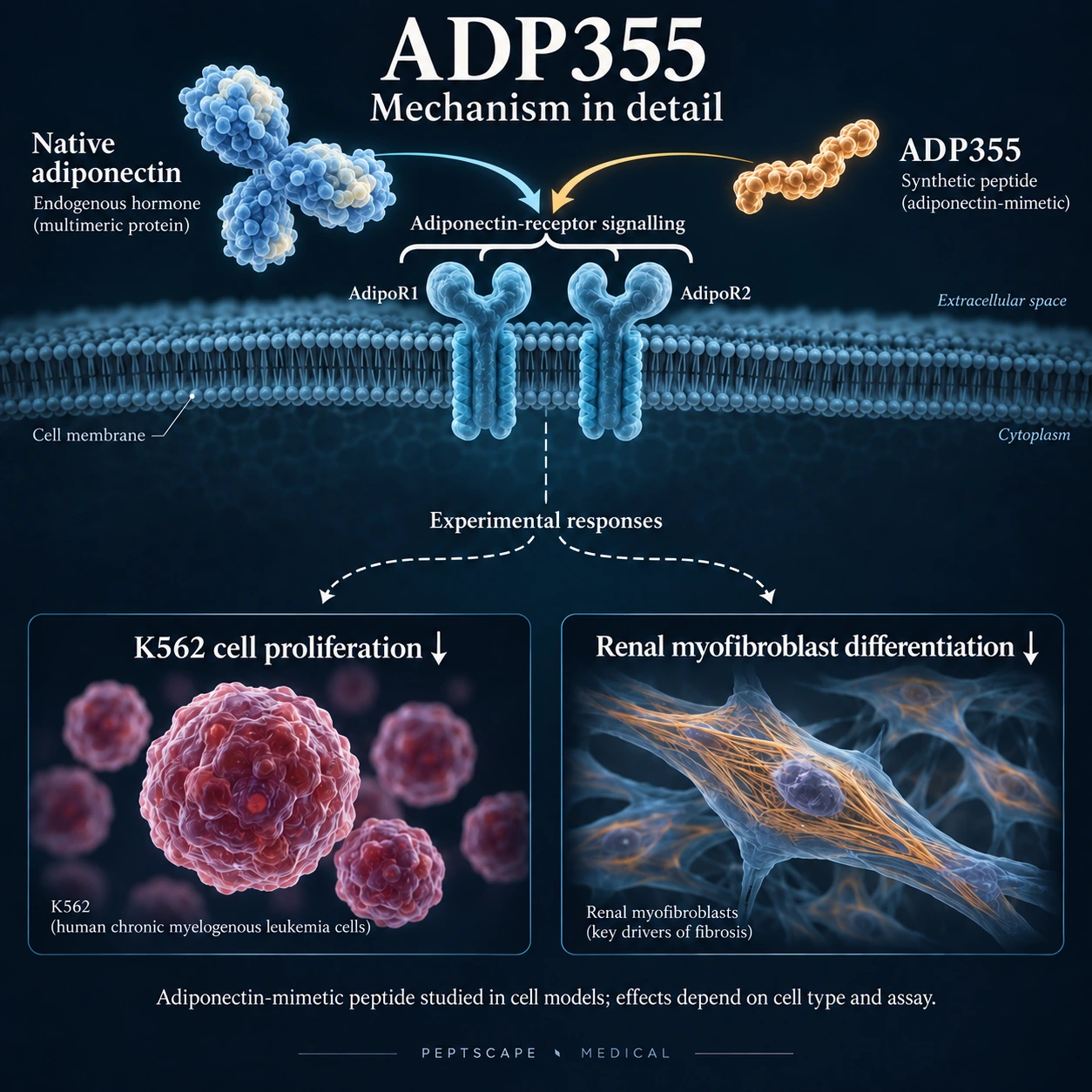
ADP355 is an experimental peptide agonist of adiponectin receptors.
Cell models; separate studies examine chemically induced injury in animals.
Peptide library
Your guide to this compound.
The liver-injury paper’s correction changes D-amino-acid positions in the stated sequence. That identity detail must be retained before interpreting activity; animal fibrosis and cell results remain separate from clinical treatment evidence.
Selected full-text methods/results or correction sections assessed.
This assessment covers selected sources and sections. It is not a systematic review, formal risk-of-bias score, or clinician sign-off.
Editorial assessment · 2026-09-07
Source 1 · pubmed.ncbi.nlm.nih.gov
Source 2 · pubmed.ncbi.nlm.nih.gov
Cell models; separate studies examine chemically induced injury in animals.
ADP355 inhibited proliferation in selected cancer cell lines and renal myofibroblast differentiation in vitro.
Cell models; separate studies examine chemically induced injury in animals.
No jurisdiction-specific marketing authorization has been verified in this snapshot; study publication is not regulatory approval.
These findings do not establish human efficacy, long-term safety, or equivalence to products sold under this name. This is a focused source snapshot, not an exhaustive clinical review. The 2016 correction changes the reported ADP355 stereochemical sequence in Methods; matching sequence and D-amino-acid positions matters. The correction was read in full.
ADP355 is an experimental peptide agonist of adiponectin receptors.
Read the study-specific findings and limitations in Medical. Mechanistic activity does not establish a treatment benefit.
The catalog primarily cites laboratory or animal research. Human benefit, a safe dose and long-term risks cannot be inferred from those findings.
The catalog primarily cites laboratory or animal research. Human benefit, a safe dose and long-term risks cannot be inferred from those findings.
Source 1 · pubmed.ncbi.nlm.nih.gov
Source 2 · pubmed.ncbi.nlm.nih.gov
ADP355 is an experimental peptide agonist of adiponectin receptors.
Cell models; separate studies examine chemically induced injury in animals.
ADP355 inhibited proliferation in selected cancer cell lines and renal myofibroblast differentiation in vitro.
Cell models; separate studies examine chemically induced injury in animals.
Otvos et al. Development of second generation peptides modulating cellular adiponectin receptor responses. 2014.
PMID: 25368867
Wang et al. ADP355 in thioacetamide-induced liver injury. 2016.
PMID: 26777428
ADP355 quantification and intravenous pharmacokinetics in rats. 2022.
PMID: 35187696
Corrigendum: Adiponectin-derived active peptide ADP355 exerts anti-inflammatory and anti-fibrotic activities in thioacetamide-induced liver injury. 2016.
PMID: 27244245
Catalog review date: Sep 6, 2026. This date alone does not establish independent clinical review.